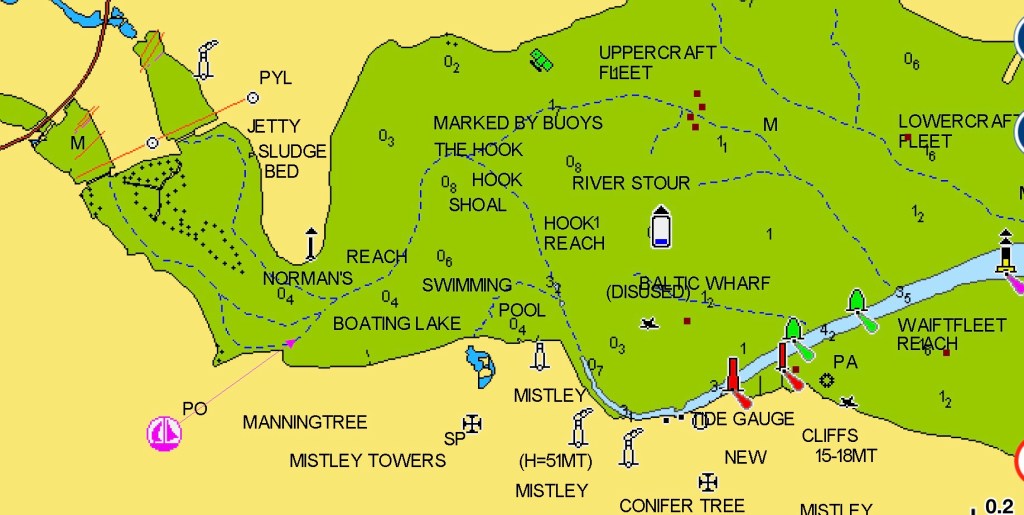
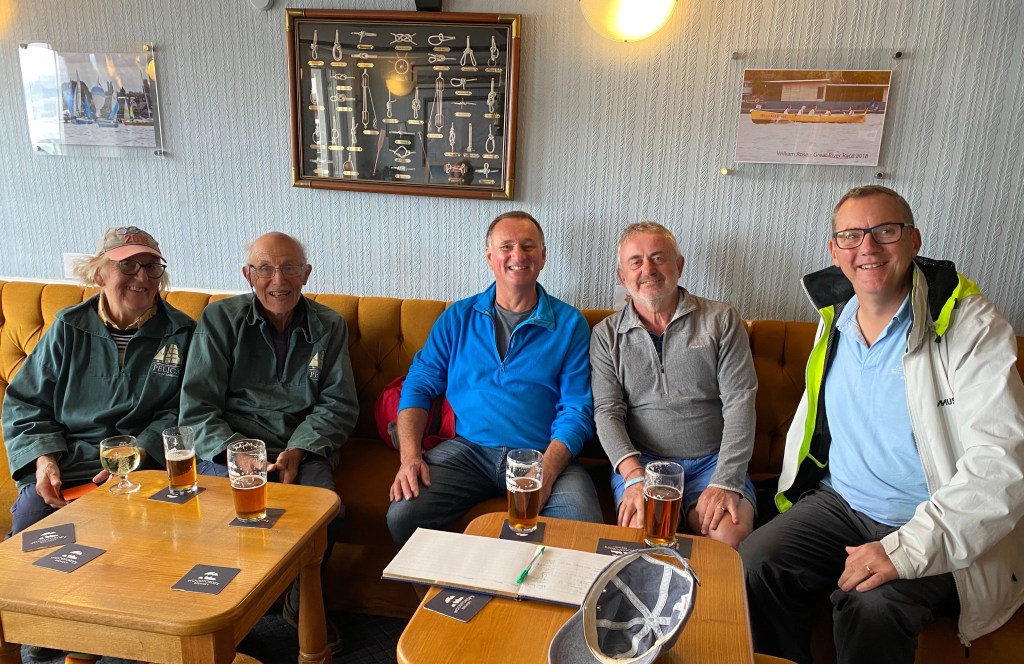
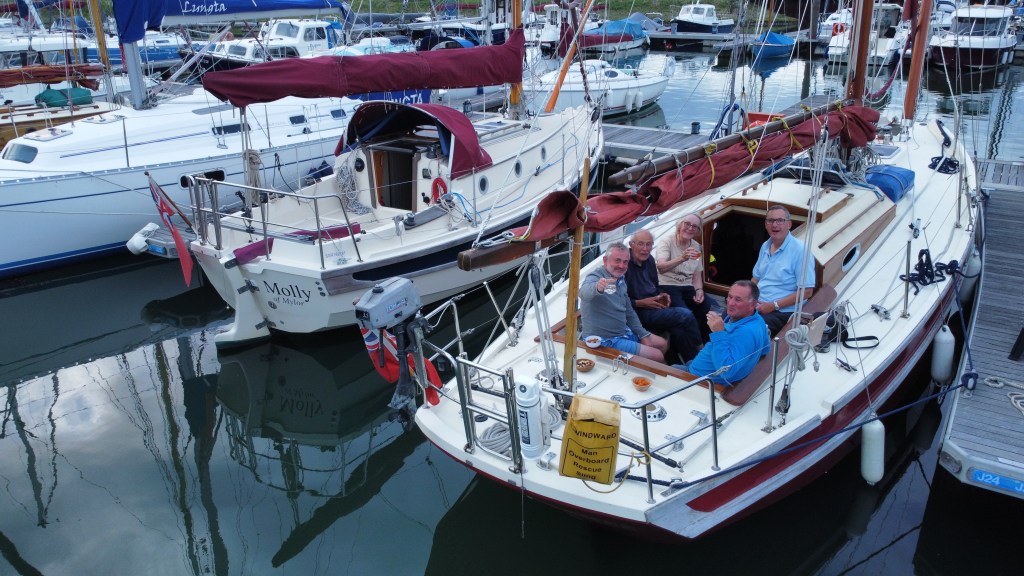
I have explored the Stour in our previous boat Aurora, a Cape Cutter 19 and I wanted to repeat a passage I had made to the navigable limit at Manningtree. The crews of the three boat that sailed from the Solent congregated on Molly with an objective to visit Stour Sailing Club for a pint.
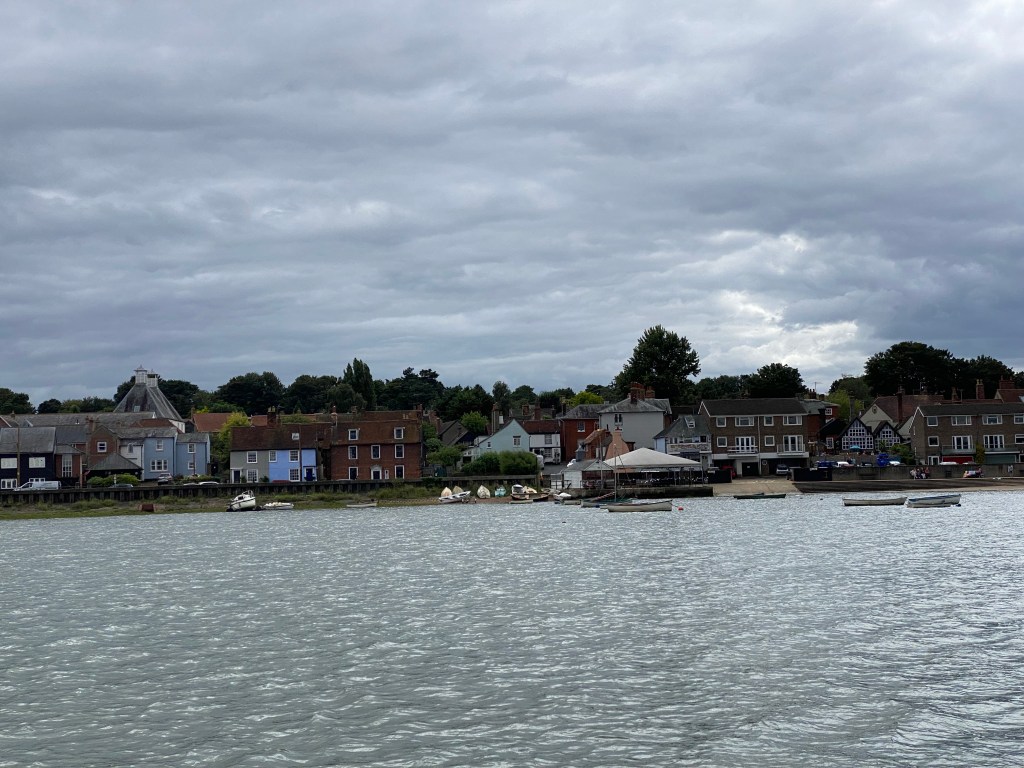
A barge leaving Mistley
It was surprisingly rough at Harwich as we left the shelter of the marina and motored into the teeth of the wind. “It’s a shame we didn’t come in summer”, Brian commented ironically.
As we progressed up river, it gradually became less choppy. We were crossed by a yacht beating up river and also admired a number of sail boarders. We also passed a large barge on its way downstream shortly before we reached its departure point at Mistley, the point where the river shows all drying green on the chart.
Manningtree is the navigable limit of the river Stour
At this point it was necessary to weave more slowly, seeking out the channel of deeper waters. Guided by the line of moored boats and a few channel buoys we approached quay at Manningtree. At first there seemed no room, but the sailing dinghies and their rescue boats were moved aside for our benefit and we moored up behind another visiting yacht.
Hesitating outside the Stour SC clubhouse, the door opened and we were beckoned in by a member, clearly used to visitors “on the clock”. We had arrived at high tide, but our stay would be brief!
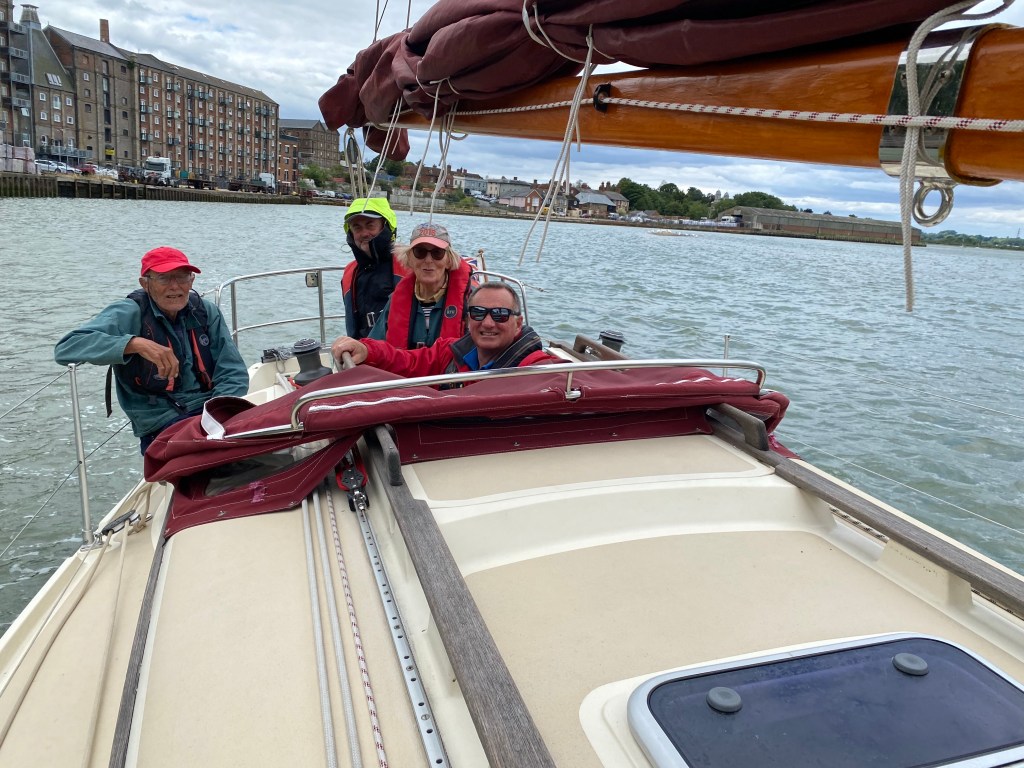
Departing Manningtree
We quickly signed in and had a round of drinks, made very welcome guests in the club, before I had to usher the crew back to Molly. Not a moment too soon, we reversed our course and gingerly retraced our steps back to Mistley. I’m sure if we had stayed only 10 minutes more, we could have been trapped by the falling tide.
Cruising back past Mistley
Once in the deeper water, we could dispense with the engine and ran back on jib only. After a much calmer trip back, we locked back into Shotley marina before another pleasant evening aboard High Barbaree.
On traditional gaffers, the gaff jaws are often covered in leather to help them slide along the mast and prevent wear on the mast. Whilst the Crabber 26 is not a traditional gaffer, I do like the “leather look” and it’s not that hard to do.
When we bought Molly, I noticed there was quite a bit of wear on the mast where the gaff saddle sits, especially in the position when the sail is furled. Some wear is inevitable on a gaffer, but it seemed excessive. Inspecting the gaff saddle, which is a pretty substantial piece of stainless on a Crabber 26, I could see that it was lined with a piece of plastic resembling a vinyl floor tile. Over time, this had cracked and split at the edges and appeared to be the cause of the wear. One thing I’ve long made a habit of doing when moored is to use an extra line to secure the boom towards the stern quarter and stop it moving. I’m sure over time, the constant shifting of the boom considerably adds to wear where the gaff saddle sits against the mast.
I have some experience of leathering gaff jaws on my previous boat, but the design of the gaff jaws is quite different on the Crabber 26 to my previous boat, a Cape Cutter 19. I took advice from those in the know, and Sue Pennison in the Solent OGA was very helpful. She suggested a “sandwich” arrangement using a saddle stitch. I bought my materials from Classic Marine in Suffolk, costing about £40 for the whole job. They supply pieces of the correct type leather; you simply specify the size you need and they charge you by the square foot (!). They also see tough rot-proof twine and sail-makers needles. Before starting, I took a diploma at the University of YouTube on how to do the saddle stitch (easy!). The photos below show the main stages in the process.
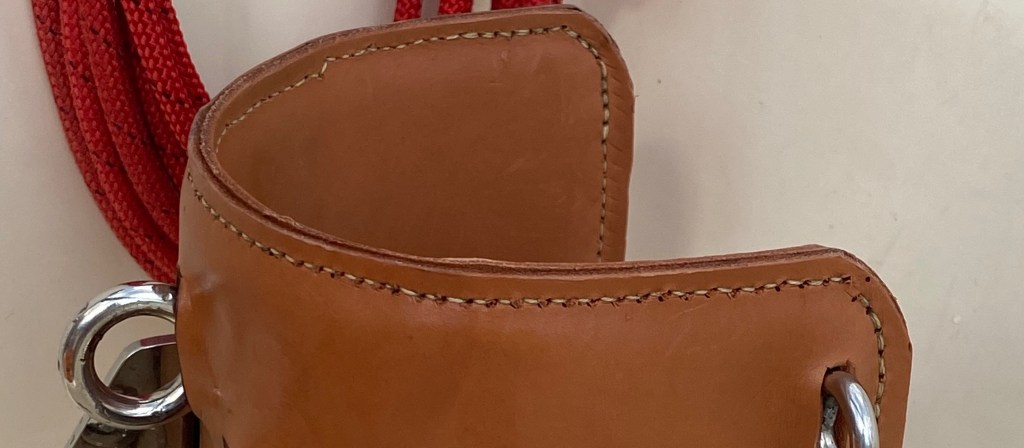
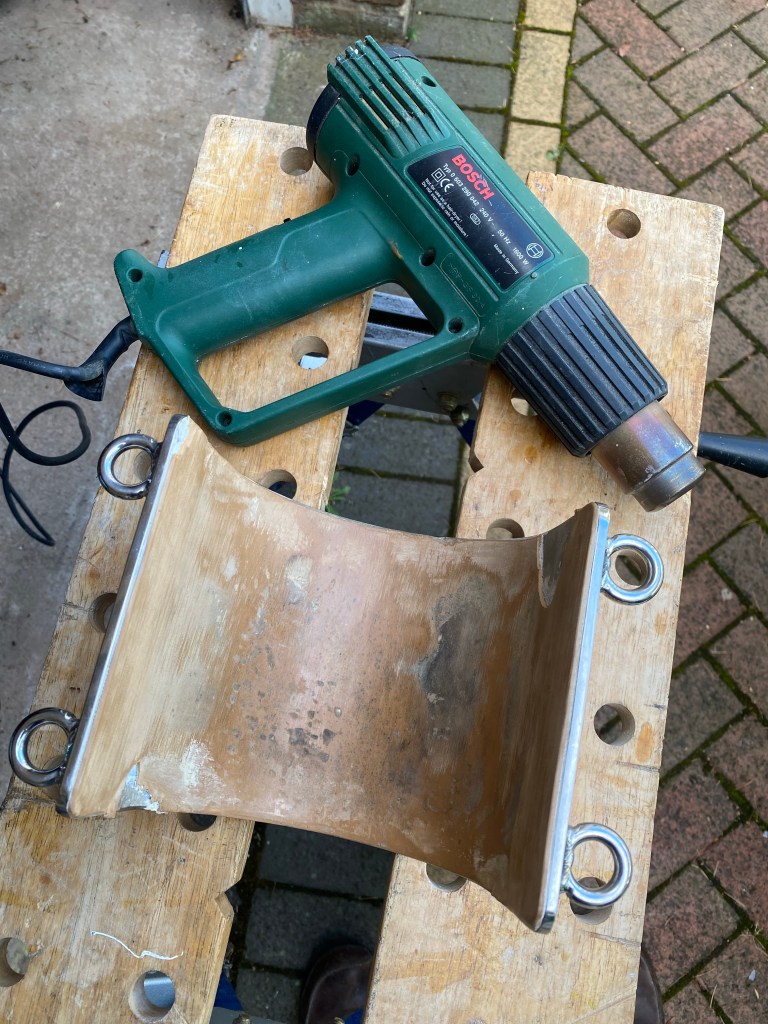
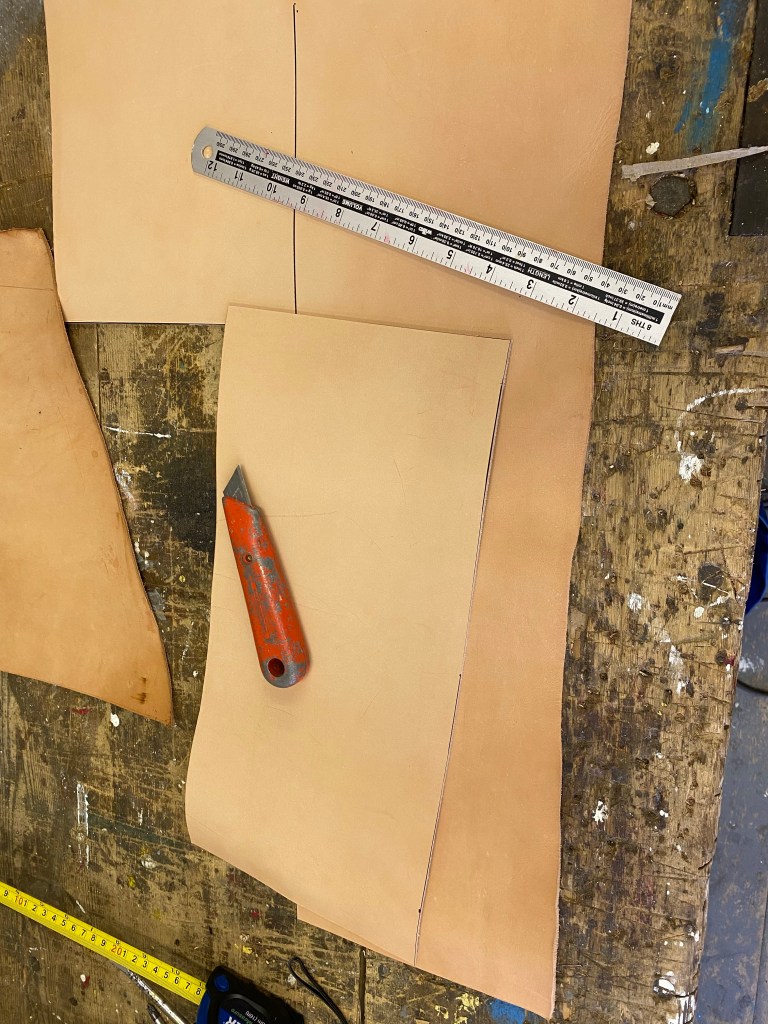
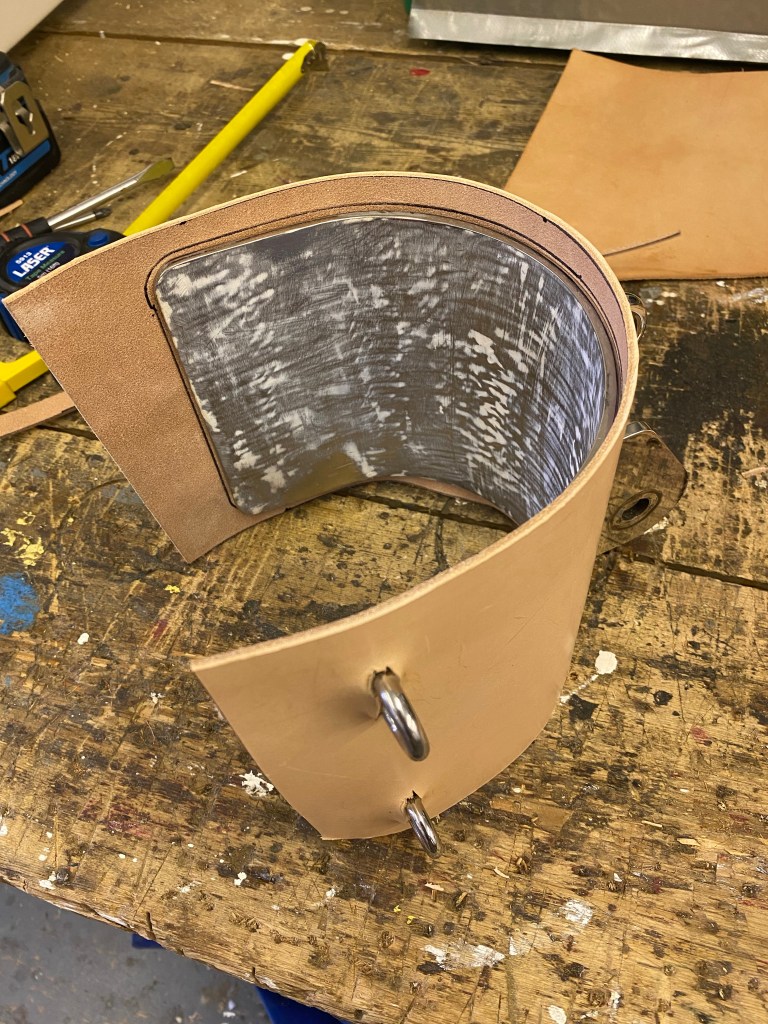
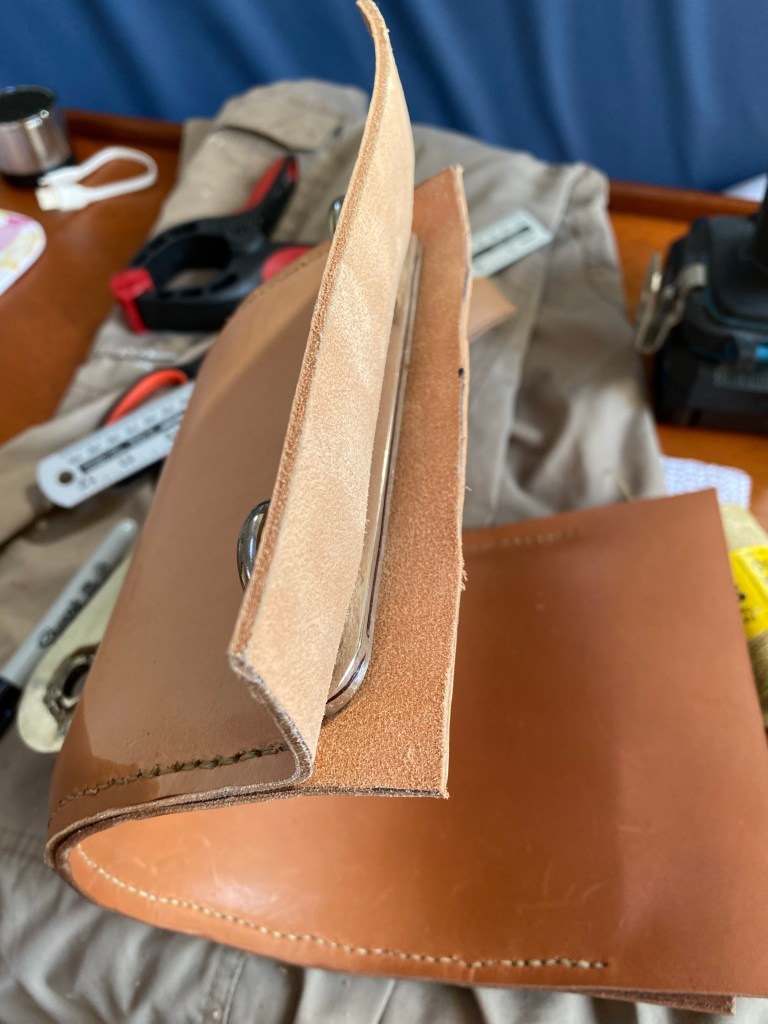
The condition of the gaff saddle when I started; you can see the damage to the original lining which I think was the cause of my mast wear. I used a paint stripper to warm the plastic and soften the adhesive – this made removing the material much easier, but I was careful to minimise heating of the metal. The leather was supplied in large rough cut pieces. After very careful measurements, I cut a piece which was the correct height (allowing for a 5mm seam top and bottom) but over-long, because I was not sure how much length I needed as the leather was stitched around the curve. The trickiest part was making cut-outs for the various fittings on the back of the saddle. Despite my careful measurements, I did make one mistake (one of the large slots was too big). Measure twice (or more!), cut once… Fortunately this error does not show when the saddle is fitted. You can see I drew an outline of the metal and then added the seam allowance. Trial fitting of the outer section. The inner piece was very easy to cut. I measured along the leather with my trusty Portland dividers, and marked with a sharpie where the holes should be, so the stitching would look even. Before fitting, I wetted the leather, to make it more supple. I held the sandwich in place with small clamps and then drilled holes. I made the holes in small batches, so that the position would be right, as the leather conformed to the curve of the saddle. Saddle stitch is a very easy stitch, using two needles cross-crossing each other. Very satisfying work!Top and bottom now stitched. The leather is ready for trimming to size at the ends.The ends now trimmed to size. I let the leather dry and then cut with a good pair of scissors. Note the holes drilled in measured positions, ready for stitching. The finished work! Overall I’m really happy with the result – looks great and, a few months later, much less wear on my mast.
We owned our previous boat Aurora, a Cape Cutter 19 for 10 years and made many friends in that time. It was how we got to know Chris and Kathryn Wicks, who live in the beautiful Pelion area of Greece and run the lovely Olive Store cottage. An added attraction of staying there is to join them on their forays aboard Kaliope, their Cape Cutter 19.
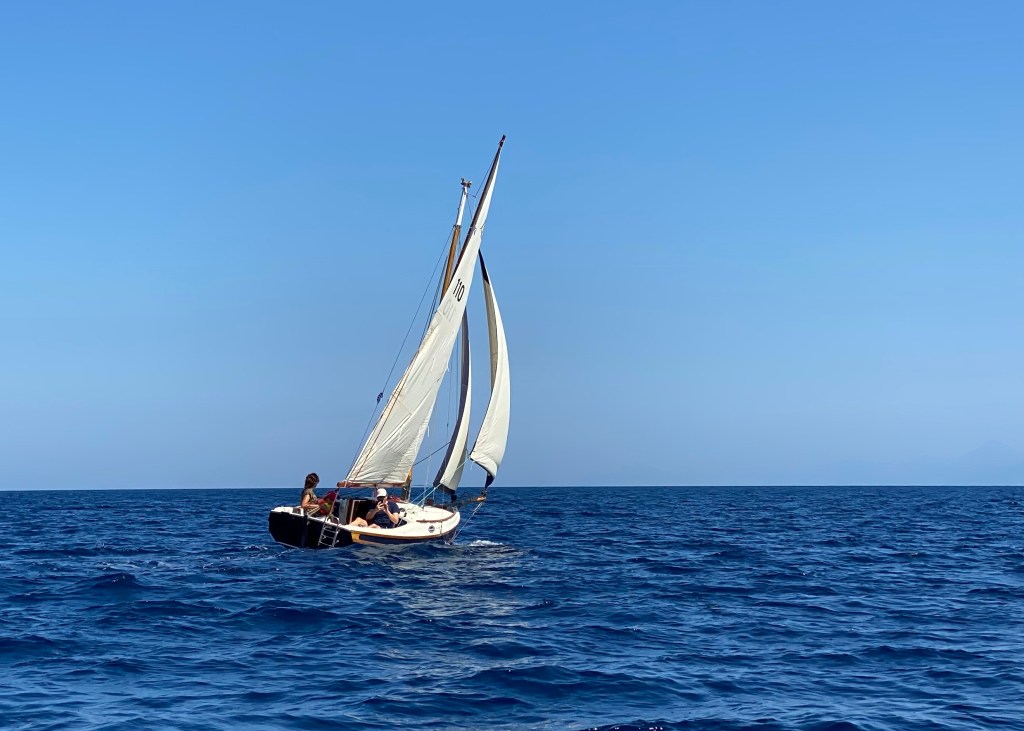
Chris at the helm of Kaliope
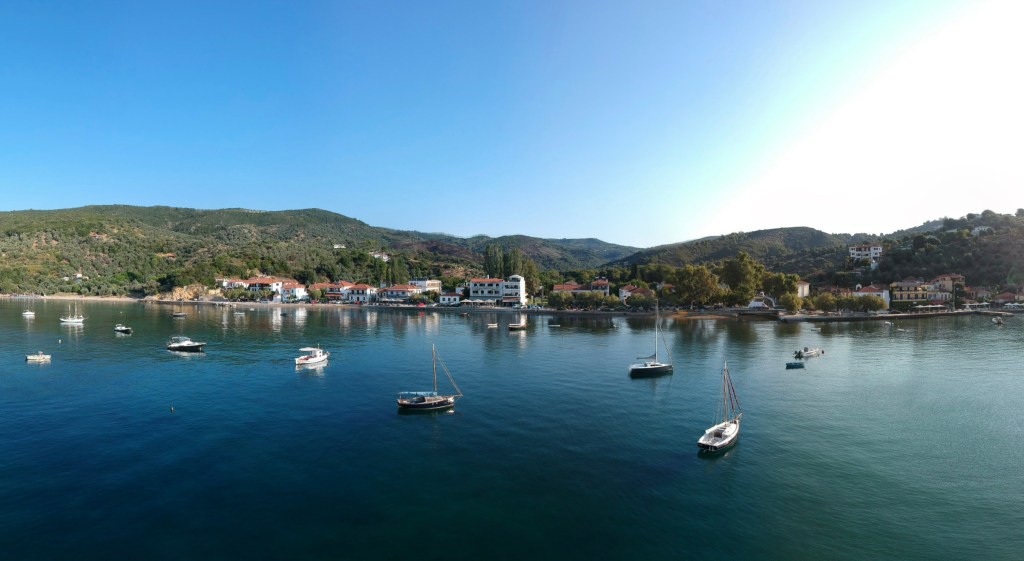
The attraction of this area is its relatively undeveloped rural character. The harbour at Platanias has a simple harbour wall at one end, to which the few commercial boats moor up, and a scattering of moored yachts. Ashore, there are a few shops and a scattering of small hotels, bars and tavernas. Even in high season, there is plenty of space on the clean town beaches. It is a fabulous base for a small boat, with an enormous amount of coast to explore. Chris has been an energetic promoter of the Cape Cutter, and there are now four based in the area.
Eliza Nell, one of the local Cape Cutter fleet
Whilst we were at Platanias, the prevailing direction was from the NE. The strength varies throughout the day, often building from nothing in the morning, to a good sailing breeze mid-afternoon, fading to calm again in the evening. This simple picture is complicated by the “valley wind” that whistles south down from the top of the mountains into the harbour, which is otherwise sheltered from the prevailing wind.
This provides interesting sailing conditions; often the wind is nearly 180 degrees different when setting off from a harbour mooring, subject to the valley wind and sheltered from the prevailing wind. One can leave the smooth harbour on a gentle zephyr, only to cross a wall of air into a stiff breeze that would knock the boat down without a double reef!
Platanias on the Pelion peninsula
All these shifty breezes are very reminiscent of my dinghy sailing days and it was a great pleasure to recapture the wonderful handling of the Cape Cutter under these very dynamic conditions. We would set off with an objective in mind, but the wind would shift in strength or direction so as to make that objective very inconvenient to reach. On other days, the wind would fade, forcing us to turn for home in order to avoid a return under motor. So it was we nearly went to many locations; one must keep in mind that the main aim is to have an enjoyable sail, so it’s best to adapt to the conditions at the time, rather than doggedly persist towards an arbitrary destination. In this way, we nearly went to Mouse Island, nearly went to Achilles’ Cave and so on.
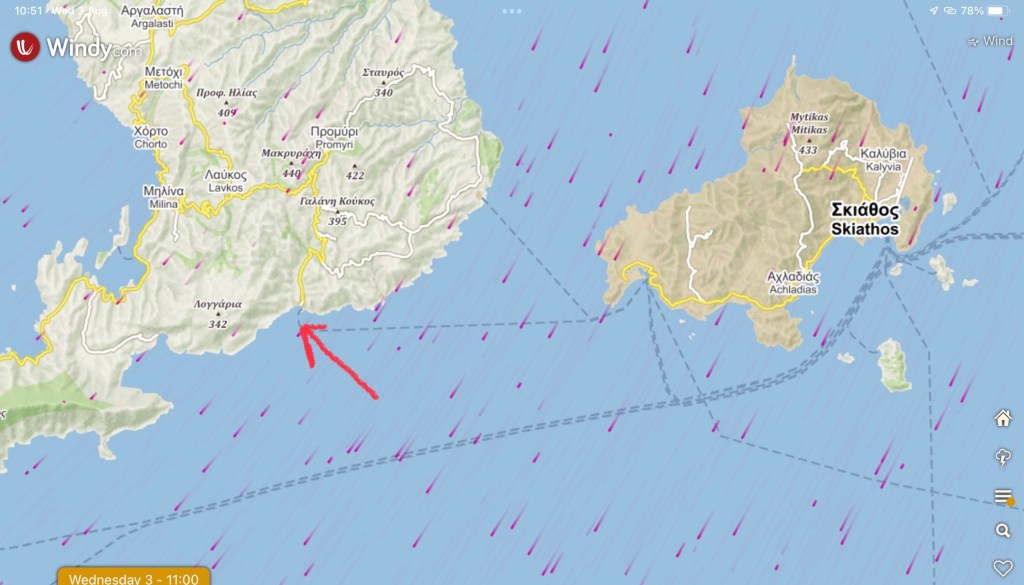
One example of this is the day we nearly went to Skiathos, the town on the nearest of the Sporades Islands. Aimee and Alice had taken the tourist ferry across for some shopping and we decided to follow them in Kaliope. The valley wind had been strong overnight, but by mid-morning was very light. Out in the main channel, we could see rough water, so put in a reef. The light valley wind allowed us to waft North along the shore up towards the point and avoid a long beat. It was clear there was quite a bit of wind outside the lee of the headland, so Chris quickly put in a second reef, just before we left this relative shelter. This was just as well, because even four-up, we would have been over powered otherwise. The wind direction was just right for Skiathos and Kaliope powered across the straights a point or two off close-hauled. The wind was well above the forecast 15-20kt and decision was quickly made to abort and run back under the shelter of the headland. It was just as well, because the wind sustained that force for the rest of the afternoon and would have made the rest of the crossing, as well as the return, quite an uncomfortable experience.
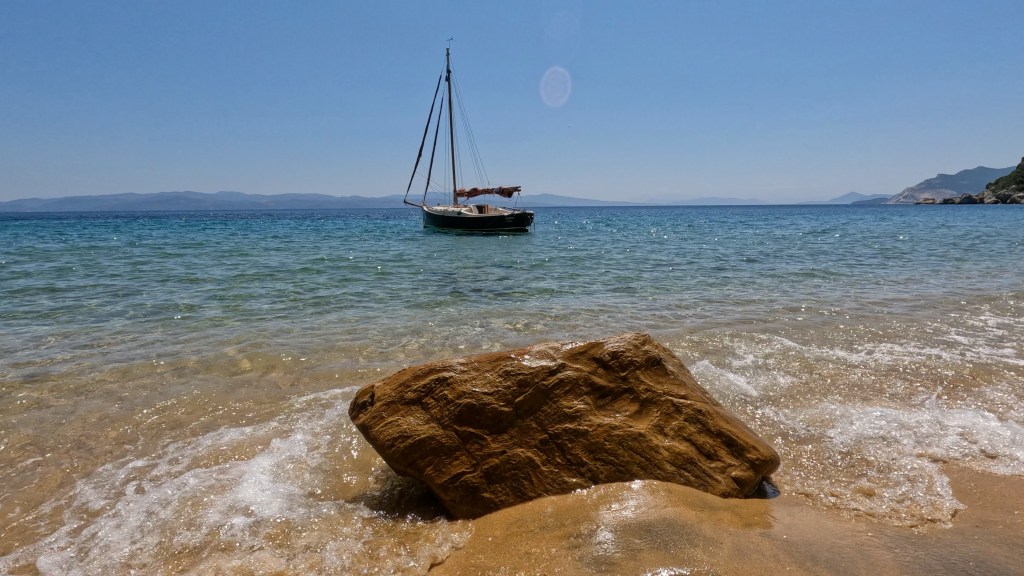
Cooling off at “Charles and Camilla” beach
As it was, we had an exciting reach across to “Charles and Camilla” (a beach our future monarch visited 20 or so years ago). After a short anchor stop for a cooling swim, we then ran back to Platanias for a pleasant lunch. The F6 was still kicking up white horses offshore in the straits but the wind was much more moderate under the lee of the headland at the “heel” of the boot which is the Pelion peninsula.
After a very agreeable meze lunch, Chris and I left the ladies to relax on the beach and ventured out again in Kaliope to meet the tourist boat’s return from Skiathos. Just two-up, a double reef and Yankee was perfect and Kaliope cut enthusiastically through the sea towards the returning day tripper boats. A few beats to windward and a wonderful run back to harbour completed the day and we were ashore a few minutes after the girls.










 Meandering Molly