Tag: anchorage

Conquering Portland Bill

The Bill of Portland

The Bill of Portland is an enormous wedge of eponymous rock sticking out into the channel. The strong tides, overfalls and eddies are very considerable and constitute a significant inconvenience, not to mention hazard to small craft making their way along the coast.

Today was exactly on spring tides, so the currents would be at their strongest and it was important to time our arrival carefully. Travelling east, this is not easy because there is nowhere convenient to wait if one arrives early (as there is when travelling West), but it is also important not to arrive late either.

There is an inshore passage which saves considerable distance, but I considered it too risky for my first passage and on springs. So that dictated that we should pass at least 3nm off, arriving at 6pm, at the turn of the tide when the overfalls were least and then take advantage of a fair tide into Weymouth bay.
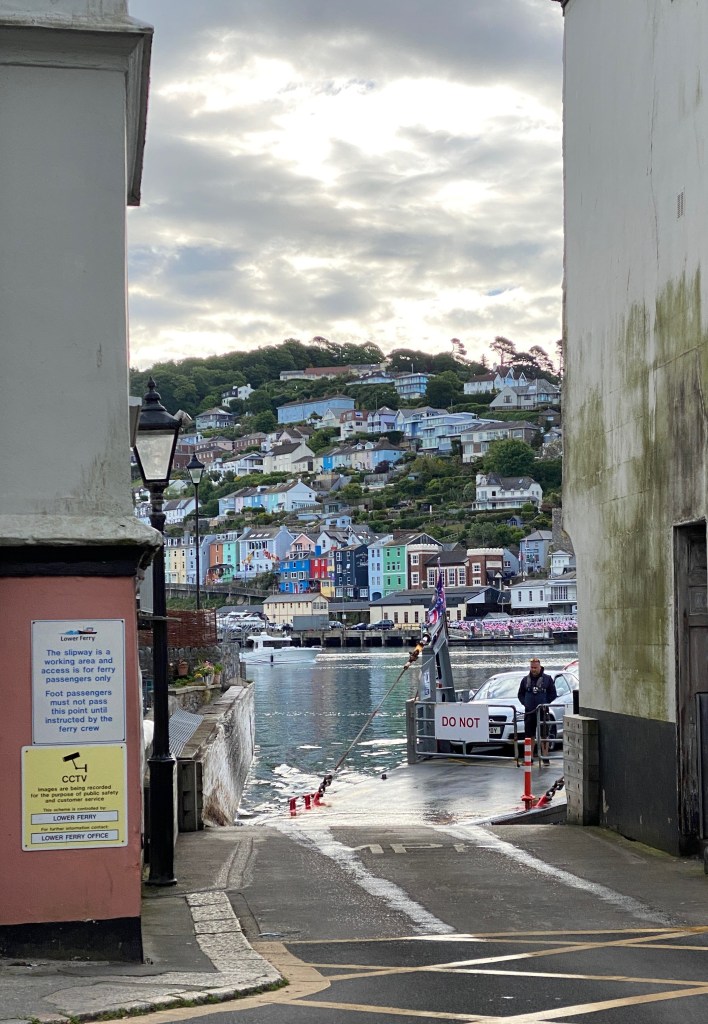
The ferry which runs between Dartmouth and Kingswear
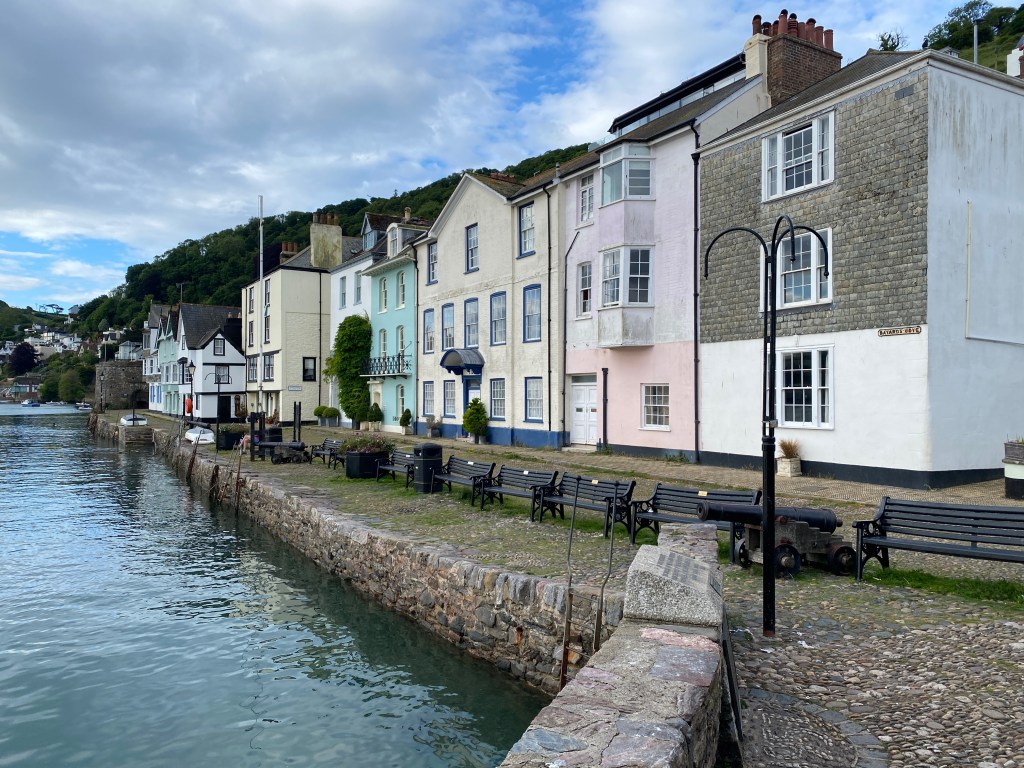
Bayards Cove, where the Mayflower and Speedwell first set off for America, before being forced to return to Plymouth for repairs to the leaking Speedwell

We took an early morning stroll around Dartmouth town, a lovely place with a lot of character and history, before taking on some provisions and departing. The provisions took the form of more pasties, in fact double rations as both Ben and I both bought some. These were definitely Devonish Pasties (as opposed to Cornish pasties) with their wacky flaky pastry!

Devonish Pasty
Offshore passage. Note Andy “the arm” Autohelm is wearing his plastic raincoat.

Our track was due East, passing the line of rocks outside Dartmouth and then opening Torbay as we left Berry Head behind. We had main up but there was little wind. As we moved further offshore, towards the invisible Portland Bill, the wind gradually filled in, to give a good training run. However the wind shifted gradually, until we were dead downwind and the jibs were not pulling.

Our track for this passage. The red dot lower right was the centre of the 6nm circle of live firing. At this scale, the chart shows The Shambles as an oval to the east of Portland

We could hear on the VHF two ships warning of live firing. “Warship Westminster” was no concern, being far to the east, but RFA Cardigan Bay was reporting a 6nm radius of live fire in our track.

This forced us to gybe in order to stay on a track which maintained our minimum 3nm offing from Portland, whilst staying out of the radius reported.
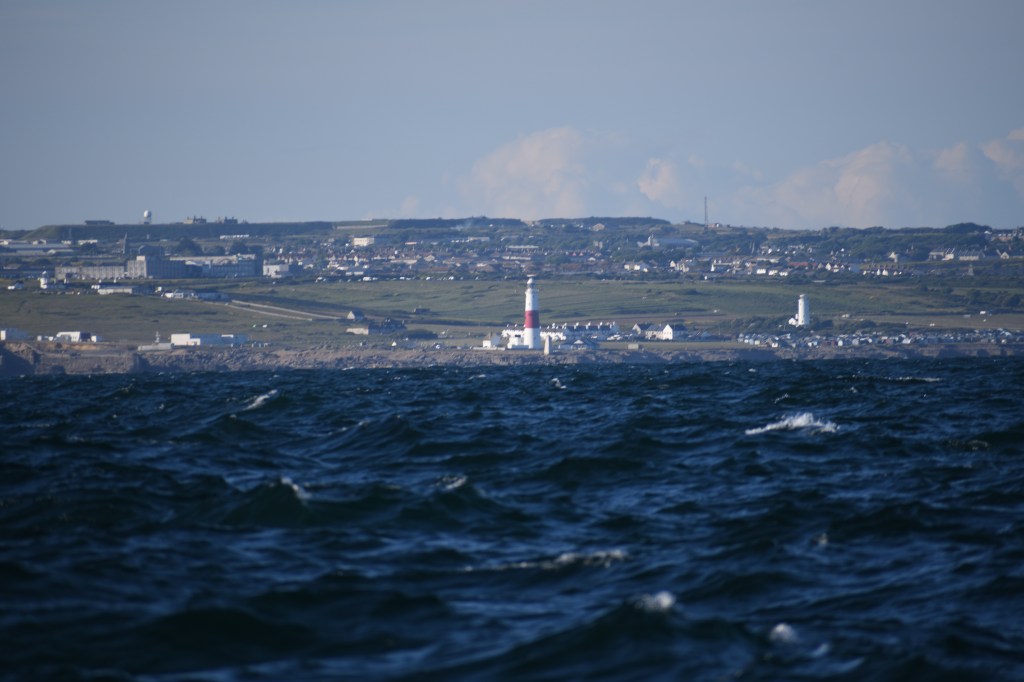
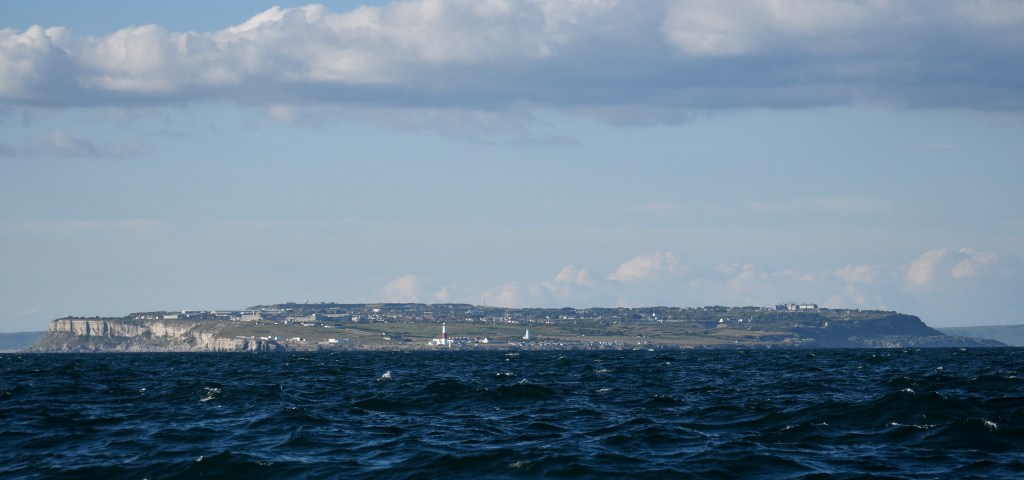
Portland light due North

In the end, the wind strength was too high for main only and we took it down (not easy in the big rollers that were forming) because the helm was too heavy without the balance of a jib sail, which weren’t setting as we were dead downwind. We continued on engine and jib and watched the enormously long wedge of cheese that is Portland Bill take on form and colour as we approached. The tide was against us; progress was slow and we reached the watershed of directly south of Portland Light at 1900. From then on, the tide built in our favour and we were soon skimming along outside Shambles Bank at over 8kt in a joyous reach.

We had decided to try the new anchor in Worbarrow Bay, at Mupe Rocks, where we would be sheltered from the SW breeze. The forecast was for the wind to drop to nothing overnight, so we were not too worried about the swell. The sun was setting as we closed the land, but we made a very efficient main sail drop in time to drop anchor, tucked into the lee of the rocks and shielded by the magnificent chalk cliffs, before twilight faded.

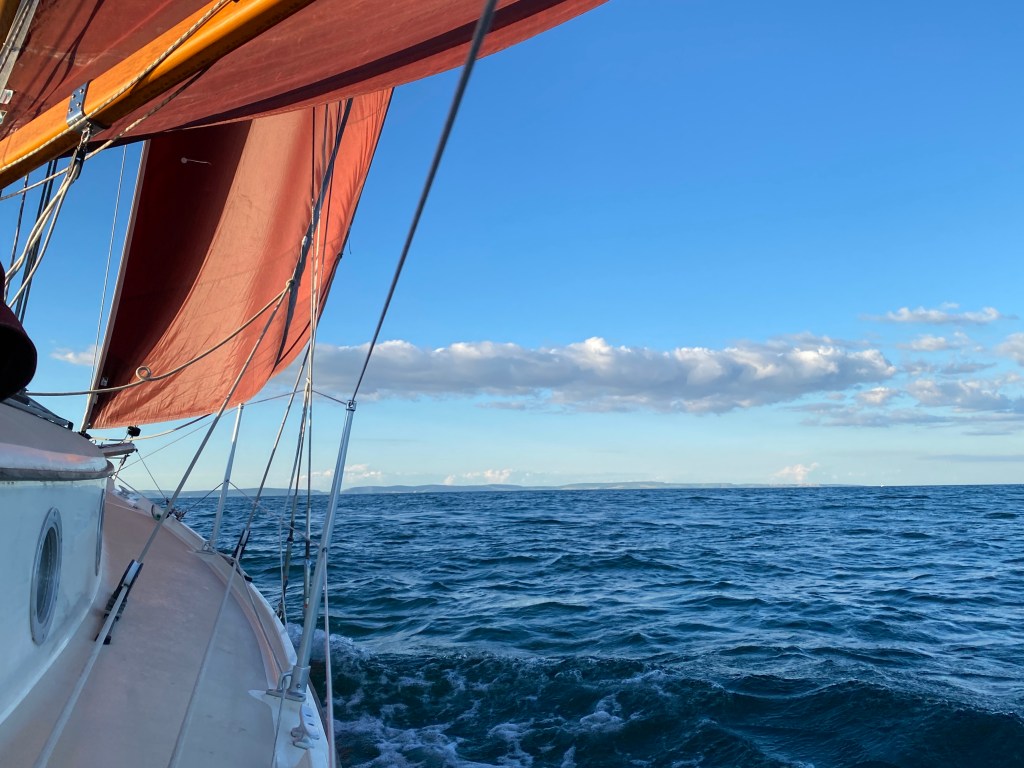
Whoosh!
Fast reach at sunset

Ben and I ate our second pasty of the day with a well-earned glass of beer before retiring to bed. I set an anchor alarm, but I was confident in “Mr Spock” (our Vulcan) – Molly came to a full stop when we had motored full astern during our anchor setting. In any case, the forecast was for the wind to disappear almost completely for the next 24 hours. Well, it did not turn out that way! The wind rose and backed to NW, which gave us the full shelter of the cliffs we were under, and Molly held her ground perfectly as she swung to the shifts and strong gusts. A resounding win for the new anchor! I woke in the night to poke my head out and was greeted by the most fabulously clear star-filled sky. I was too tired to admire it for more than a few moments before returning gratefully to my warm berth.

Starry night at Mupe Bay

Anchor angst and the Yealm

We were anchored off the beach at Cawsand. I’ve never been ashore at Cawsand, so the plan was to inflate the dinghy and explore the twin villages of Kingsand and Cawsand. Niki said “are you sure it’s safe for us to all go ashore?” Prophetic words. “It’ll be ok”, I judged.

“Anchored” in Cawsand Bay

There was a gentle onshore breeze and the three of us landed easily in the tender. The villages, separated by only a few yards, but which historically had been at loggerheads for many years, were indeed lovely, especially with the decorations up for the queen’s Platinum Jubilee.

Narrow streets with jubilee decorations in Kingsand

At several points we could see Molly from afar and observed that she was still in position. As we walked along the shore, Niki said “I’m sure she’s moved”. We quickened our pace. By the time we had regained the dinghy, it was clear that the wind had increased to about F4 and Molly was dragging.

Is she dragging ?

The waves on the shore were not so easy to negotiate as our arrival and it was a much more strenuous row. We agreed that as soon as we reached Molly, I would go to the bow and Ben would start the engine, whilst niki remained in the dinghy. There were a scant few metres between Molly and the shore when the engine was engaged, but the anchor was soon recovered and the only casualty was poor Niki, who not only had a good soaking in the dinghy but cut her hand into the bargain.

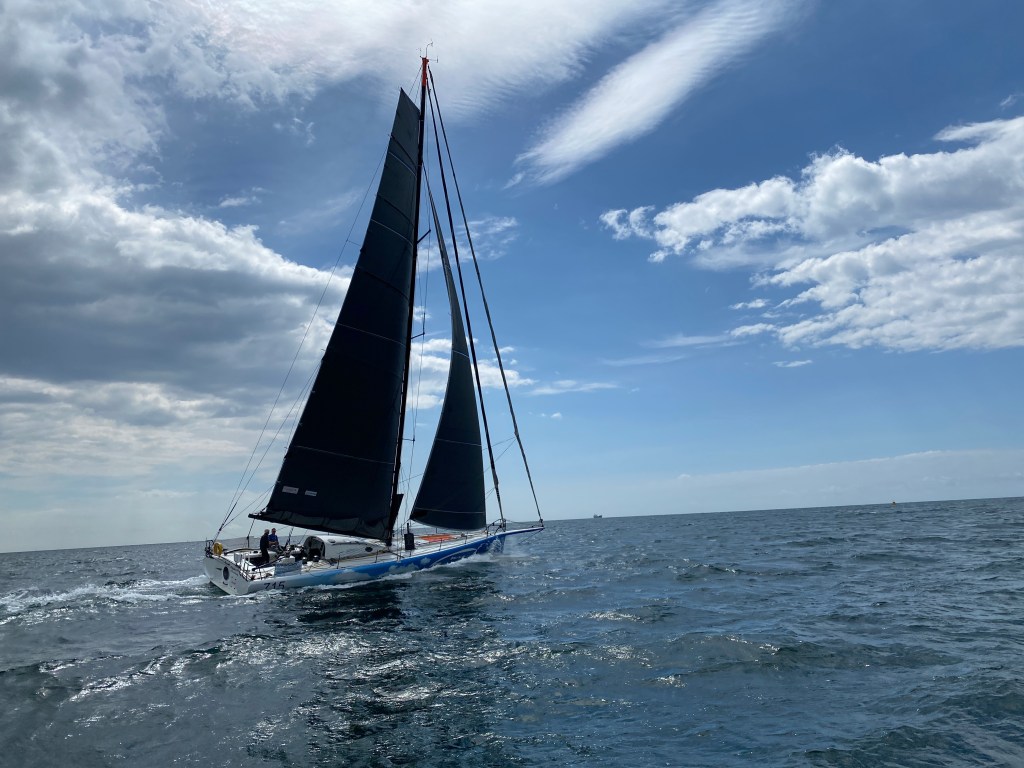
Niki retired below to warm up under a blanket , whilst Ben and I motored across Plymouth Sound. It was slow going, dead into the wind and we also had to contend with crossing the track of a magnificent fleet of flying offshore racers heading for Galway and thence Shetland.

Eventually we reached our planned lunch stop and dropped the plough anchor for the last time in Cellar Bay at the mouth of the Yealm. By this time I had very much decided that my plan to eventually replace it should be brought forward to a status of immediate.

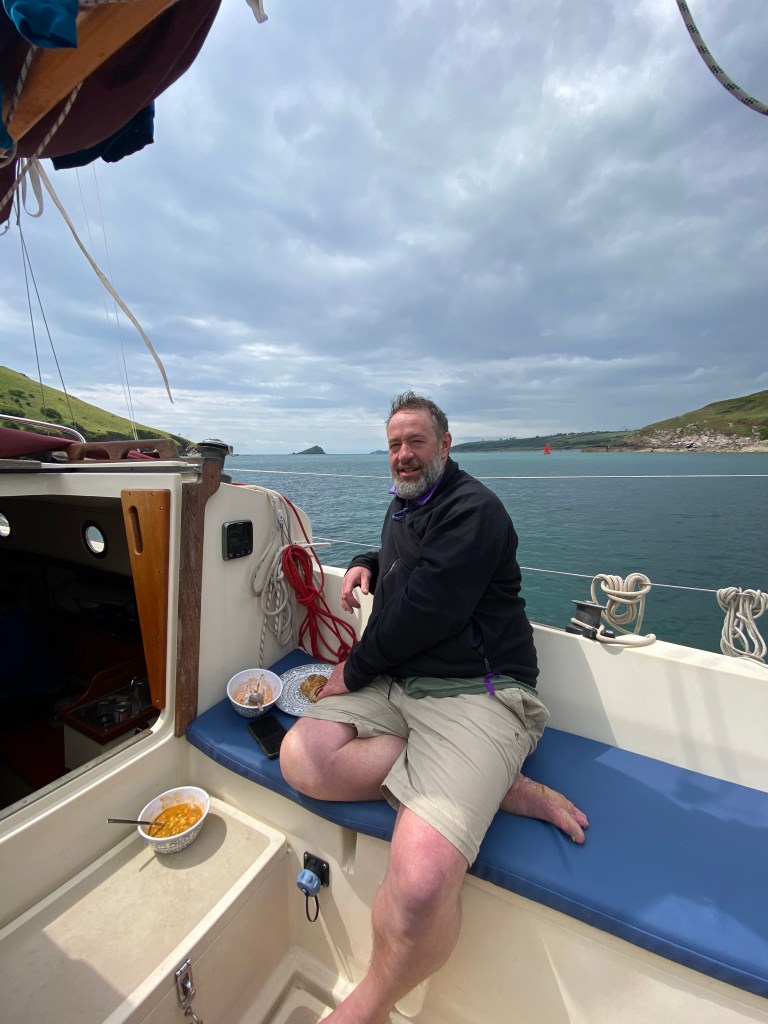
Lunch in Cellar Bay at the mouth of the Yealm

We enjoyed a pleasant lunch and siesta before hosting Dermot, our friend and fellow Crabber 26 owner, who lives nearby and sailed out to see us in his Drascombe Dabber. Sadly rain prompted him to return home but we elected to motor up the Yealm despite the steady rain. It’s a most beautiful spot, even in the downpour. We motored up to Noss Mayo, though we didn’t stop for a pint!

Our return to plymouth sound was another motor session, after we had motored into a strong wind all the way to the Yealm, there was no breeze at all for our return. After that plod, we were happy to arrive at Sutton Marina. We enjoyed a meal of Morroccan Lamb with butternut squash, which Niki had prepared earlier and cooked in our Thermal Cooker.

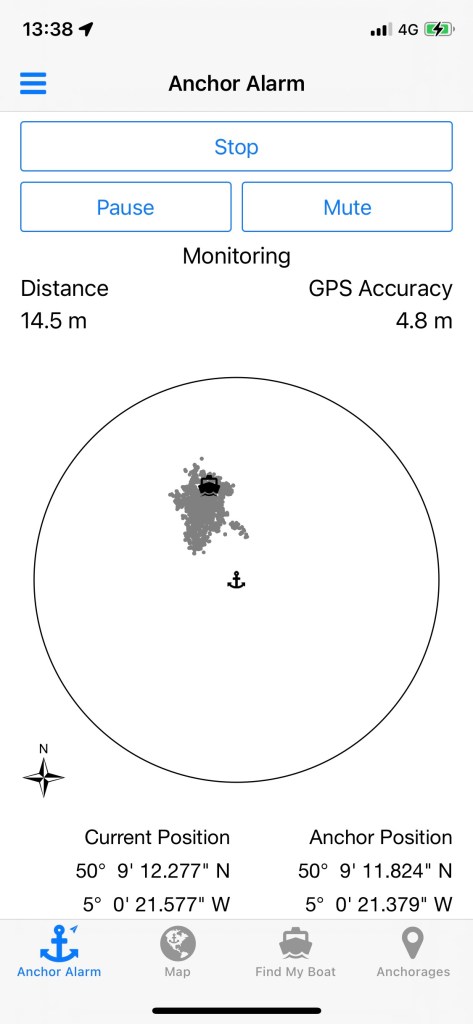
Anchor Alarm

I enjoy anchoring overnight- one of the pleasures of boating is to find out of the way places and enjoy some peace and quiet. However, in the back of my mind, there is always some concern about whether the anchor will hold, particularly at the turn of the tide, and this can make one’s sleep rather light.

I was always confident in the holding of the rocna-style anchor on our previous boat. Aurora, but the holding of Molly’s pin is unknown to me. I have been using an app called Anchor Alarm to monitor my position. Particularly useful at night, it will alarm if the boat moves out of a predetermined circle. I usually test this by leaving the anchor alarm active when lifting, to check it does the job. I also leave the phone connected to power overnight, as the GPS has a tendency to drain the phone battery.

There are many such apps to choose from, but the features i was looking for are the ability to set the anchor position after dropping the pin (I’m too busy at the time!); to allow for anchoring depth and scope; the app must be able to work in the background, so I can use my phone for other things and finally, some form of graphical display of the boat’s position over time is useful.

After some research, I found Anchor Alarm fulfils all of these criteria. It’s not free and it doesn’t have the ability to remotely monitor the boat position (ie if you go ashore whilst anchored), but I felt I didn’t need that feature. The display is simple and clear and most importantly, it provided me with a sound night’s sleep!

Edit: A few days after writing this, I anchored in St Mawes and the anchor dragged. I think it was due to an improper set of the anchor and/or not enough scope. In any case, the anchor alarm earned its fee because it went off when I was down below and gave me time to start the engine and lift the anchor before we dragged onto another boat.

Helford sortie

Left on my own, I decided to revisit an old haunt up the Helford river to try anchoring overnight. I’d not sailed Molly solo yet and was also not confident about being able to reef. However, the light winds provided ideal conditions to try things out – the auto helm makes everything straightforward, freeing me up to pull the string. In fact I very much enjoyed the sensation of the boat helming herself and me able to look around, move about the boat and make adjustments without going off course. I know all this is old hat, but it’s new to me!

I had a most pleasant sail across Falmouth Bay, towards Manacle Reef on full main and staysail. As the wind increased from F1 to F2, increasing weatherhelm was evident, but I decided not use the jib until I had a bit more experience handling the boat and neither was I able to get the reefing to work yet. I did not make a good job of tacking on this trip, and I kept finding myself in irons (presumably not helped by the weather helm – that’s my excuse, and I’m sticking to it) and the boat kept losing way in the light airs.

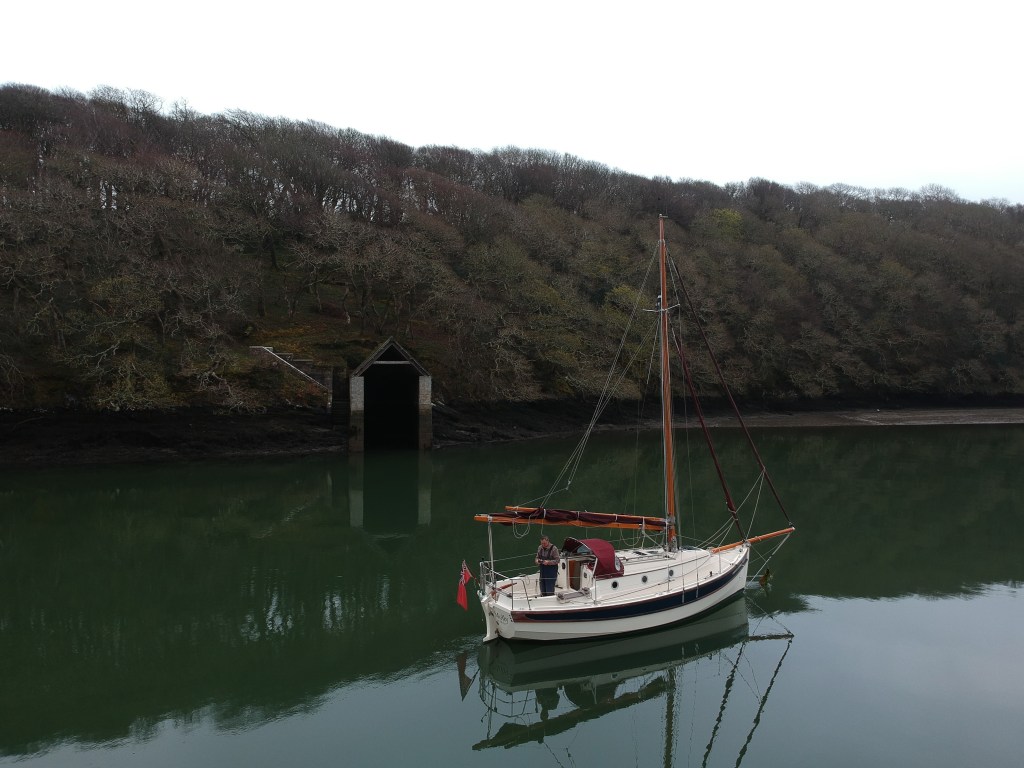
When I reached the mouth of the Helford, I experienced difficulty furling the staysail again and ended up dropping it on deck. Lazy jacks for the main are also going on the To-Do list! I motored up the river, past the multitude of moorings to Tremayne Quay. This is a lovely stone jetty and boat house which was built for a visit of Queen Victoria that she never made, and is a very fondly remembered spot we visited in our previous boat, Aurora.

The chart shows green here, but there is a “hole” outside the boathouse and I calculated that there would be at least 2m of water in that spot at low tide. Low tide was also conveniently before bedtime, so I could sleep soundly afterwards, knowing that there would be no need to check the anchor was re-set at the turn of the tide. In the event, the flow was gentle enough that the light breeze kept Molly in the same spot all night.

Tremayne Quay
Canoes in the mist

It’s a very peaceful spot to stay, beyond most of the traffic and also easy to land, with pleasant walking in the woodland on the W shore. However, inflating the dinghy was a job for another night, I decided. Whilst in the calm I had a look at the reefing lines and decided that the difficultly in reefing was mainly down to friction in the single line system. I saw from the Crabber Club forum that I was not the first to experience this and instituted a simple change recommended there. I had bought some strong stainless rings from Trago before I left Falmouth and tied a pair of these through each of the reefing eyes. This means that the reefing line, instead of passing through the reefing eye, passes through the ring. This had the effect of swapping the reefing lines over in the cockpit, and makes it significantly easier to pull the reefs in. There is still a lot of friction for second reef and time will tell if this is a permanent change, or perhaps I will go a stage further and purchase some (much more expensive) low friction rings. In any case in the longer term I will need to make a tidier job of my current arrangement.

I was pleased to find my calculations correct; I did not touch at low tide and I spent a restful night on the river. In the morning, I made an earlyish start to leave before low – although there is enough water at low where I was anchored, I was not sure if I would get down the river at that time. Weighing anchor roughly 2hrs before LW, I weaved my way keeping to the deeper part of the channel and soon found my way to deeper water. There was almost no wind, so I motored over to St Makes. I dropped the pin in less than a metre of clear water at Cellars Beach, opposite Place House, a most elegant 16th Century manor, in which King Henry VIII had one of his multitude of marriages. I chose this spot not just for its outlook but to be out of the wash of traffic and spent most of the day working. What a great spot for an office!

In the evening I returned to Falmouth and inflated the tender for her inaugural voyage, rowing ashore for a pleasant evening with Ben.

Anchored with St Mawes in the background
Lovely clear water
Place Manor in the background