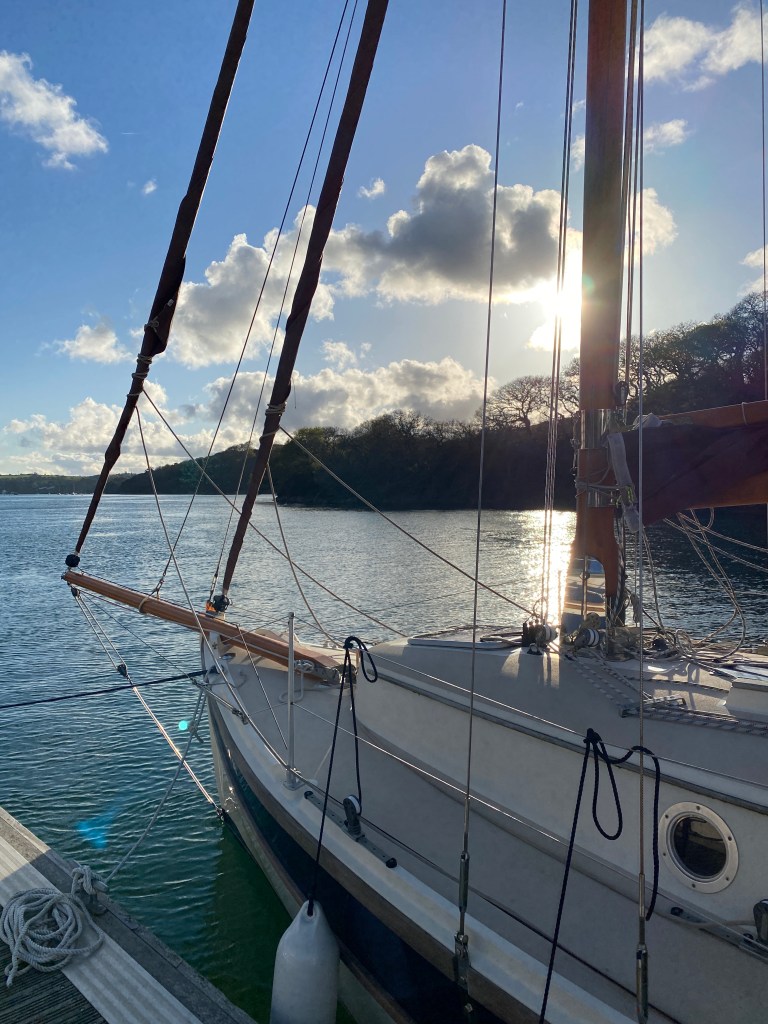
Chichester expedition

Romping home on Sunday morning

This was Alice’s first sailing trip since we took over Molly, and she was very pleasantly surprised with the accommodation; as it was just me and her, I gave her the forepeak, much to her satisfaction. The weather was ideal, with warm sun and a nice SW sailing breeze. We had a leisurely start and enjoyed the hustle and bustle of Portsmouth harbour as we followed the steady stream of boats leaving harbour on the falling tide.

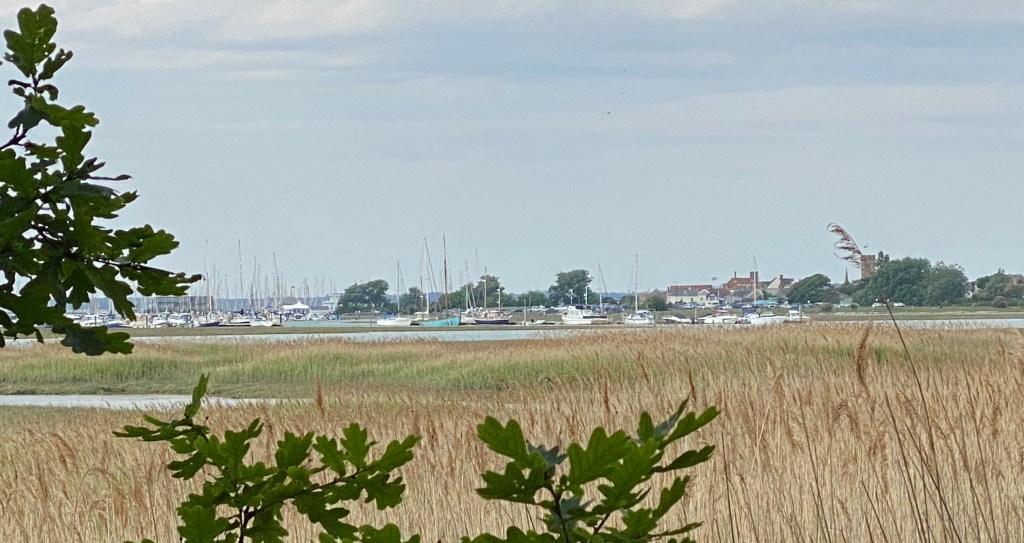
Once we were clear of the Isle of Wight ferry and hovercraft tracks, we turned to port and made for the boat passage through the old submarine barrier that stretches south from the shore near Southsea pier out to Horse Sand Fort a mile and a half offshore. From there, it was a spirited run east, past Winner sand at the entrance to Langstone Harbour and on to Chichester. In no time at all, we reached West Pole, marking the southerly extreme of the channel into Chichester harbour, and gybed round to reach up the channel. On previous occasions when I’ve followed this track, I have been in Aurora (our previous boat, a cape cutter 19) and not worried about depth. This time, though on a neap tide, it was nearly low water, and I paid close attention to the depth as we crossed the bar. With the sea flat, there was plenty of water and we soon slipped past Hayling Island sailing club and turned to starboard towards the popular anchorage at East Head. As expected on a sunny Weekend afternoon, the spot was thick with boats at anchor, among which weaved a multitude of sailing dinghies.
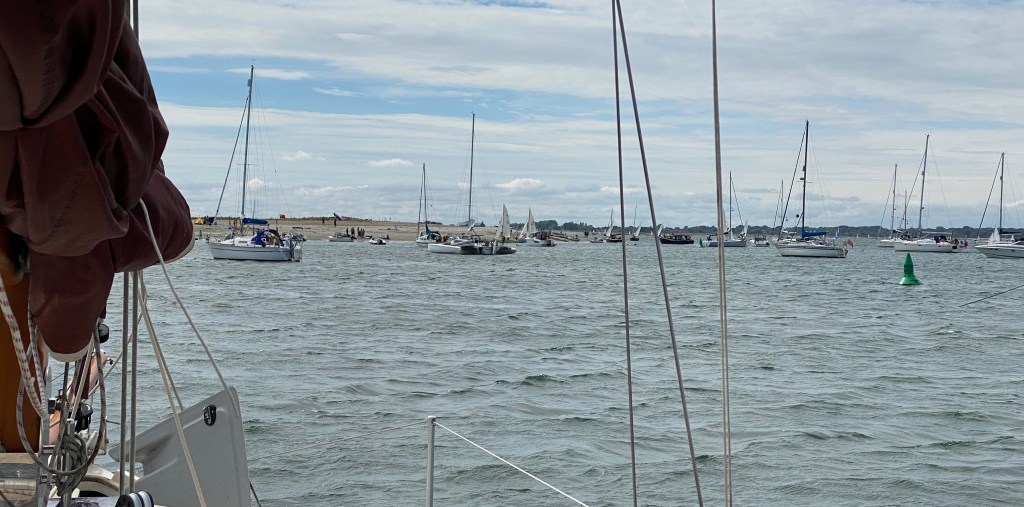
Busy East Head

With plate up, Alice motored us into the wind towards the sandy beach, but unfortunately, I underestimated our speed and Molly touched the bottom. I quickly dropped the anchor and ran astern to see if we could motor off, but Alice had already tried this and Molly was firmly aground, so I returned to the bow and heaved on the warp to keep the bow pointing into the F4 breeze. We were secure and I knew the tide was already rising, so there was nothing for it but to have some lunch! With a little more water, I checked the anchor had set and then increased the scope to ensure good holding. I suggested moving up the Thorney Channel to get a little more shelter behind Pilsey Island, but Alice preferred the existing location.

We passed a relaxing afternoon and later made a paella(ish) from ingredients we had bought in Gosport. I say “ish” because the low-cost, German-owned supermarket with a four letter name famously is always short of an ingredient or two, in this case risotto rice and saffron. Nevertheless, we had tasty rice and fish with sugar snap peas, all from the thermal cooker.
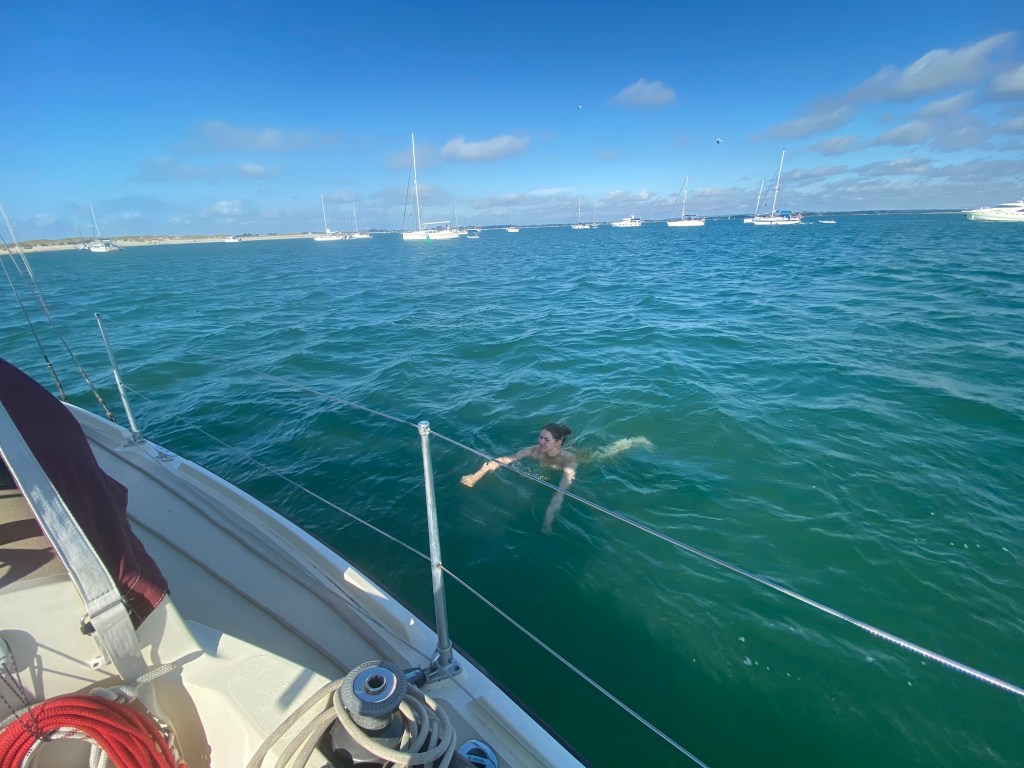
Morning swim

I expected the wind to ease off at nightfall, but it maintained steady 15-20kts all night. This made for a less peaceful night than I had hoped, but further increased my confidence in Spock, our (relatively new) Vulcan anchor. By my reckoning, Spock needs to provide 13 nights at anchor to pay for himself; this was night three.

We awoke to another fine morning with a steady SSW breeze. It was due to veer towards SW, so I was keen to set off and avoid beating if possible. We left in good time, but not before Alice had a refreshing swim.

It was a tad bumpy at the entrance to Chichester, but the sea was quite smooth once we reached deeper water south of west pole. The wind direction was perfect for fetch back across to Portsmouth. Most of the boats in the procession leaving Chichester turned off before this and followed a track closer to the shore, heading for the small boat passage we used yesterday. I had decided that instead we would enjoy the sail and take a longer track to pass outside the Horse Sand Fort.

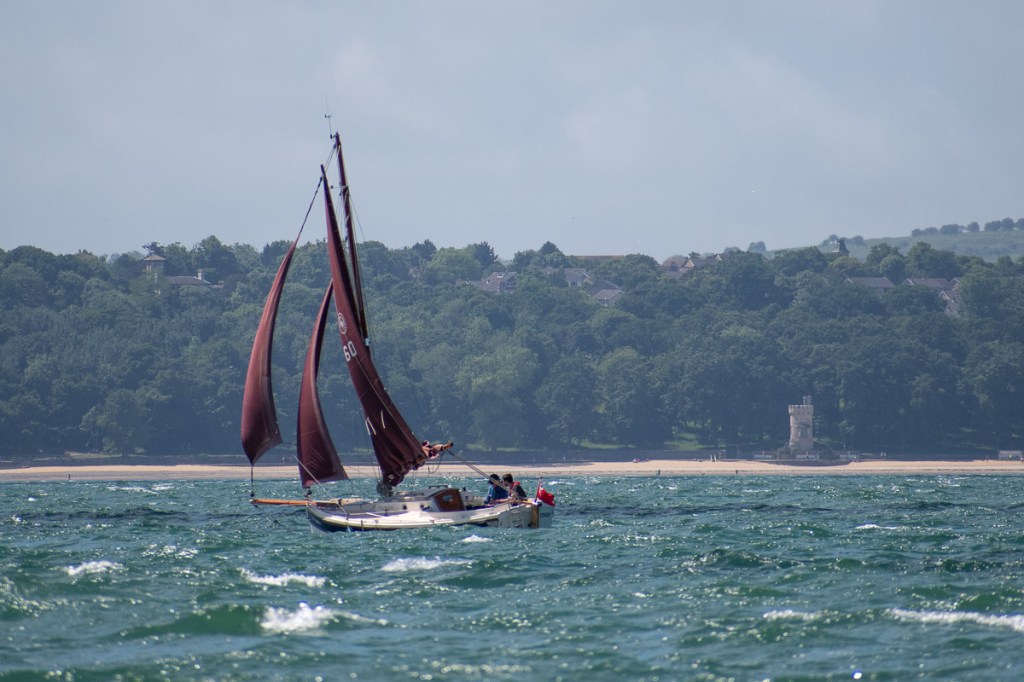
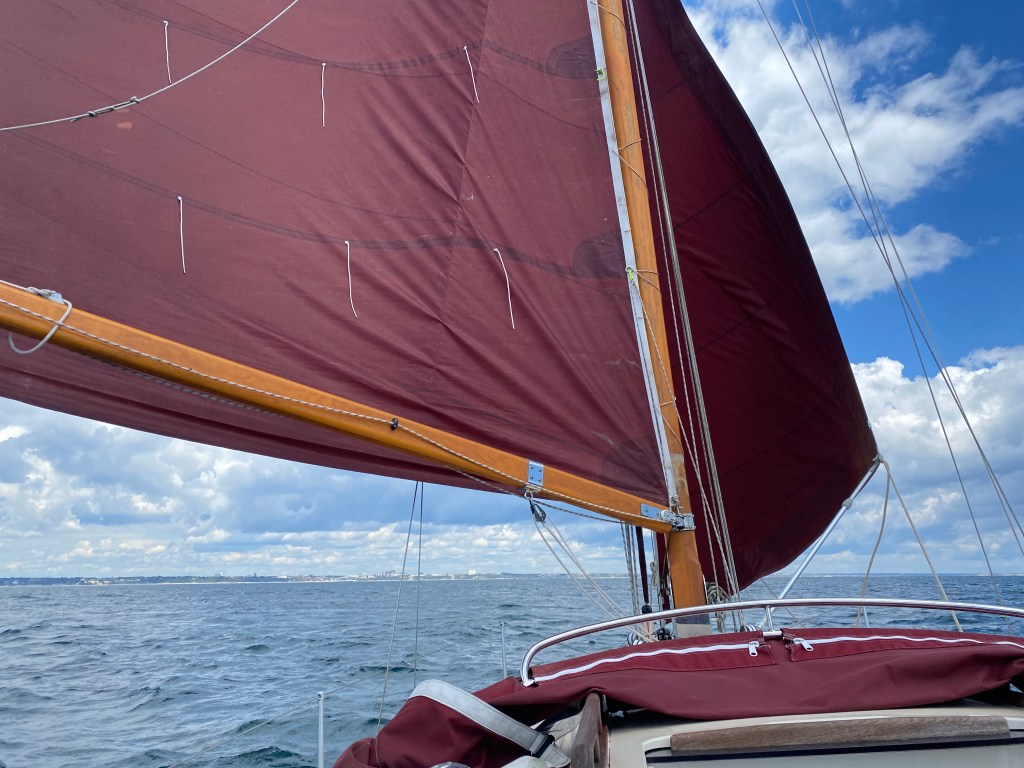
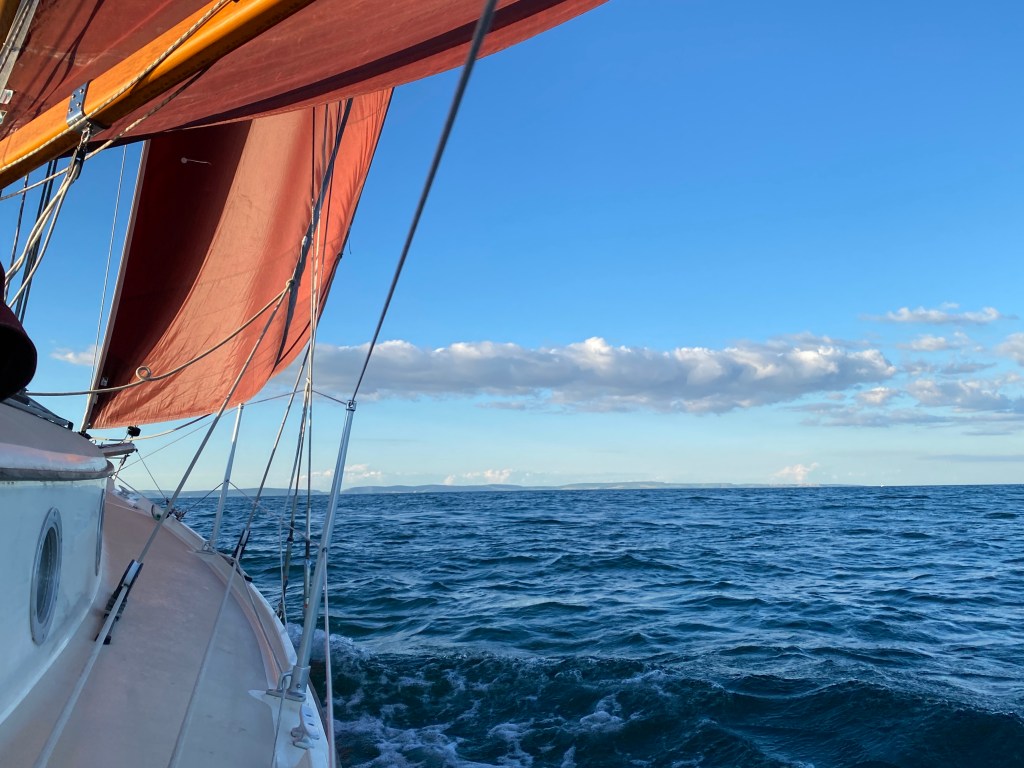
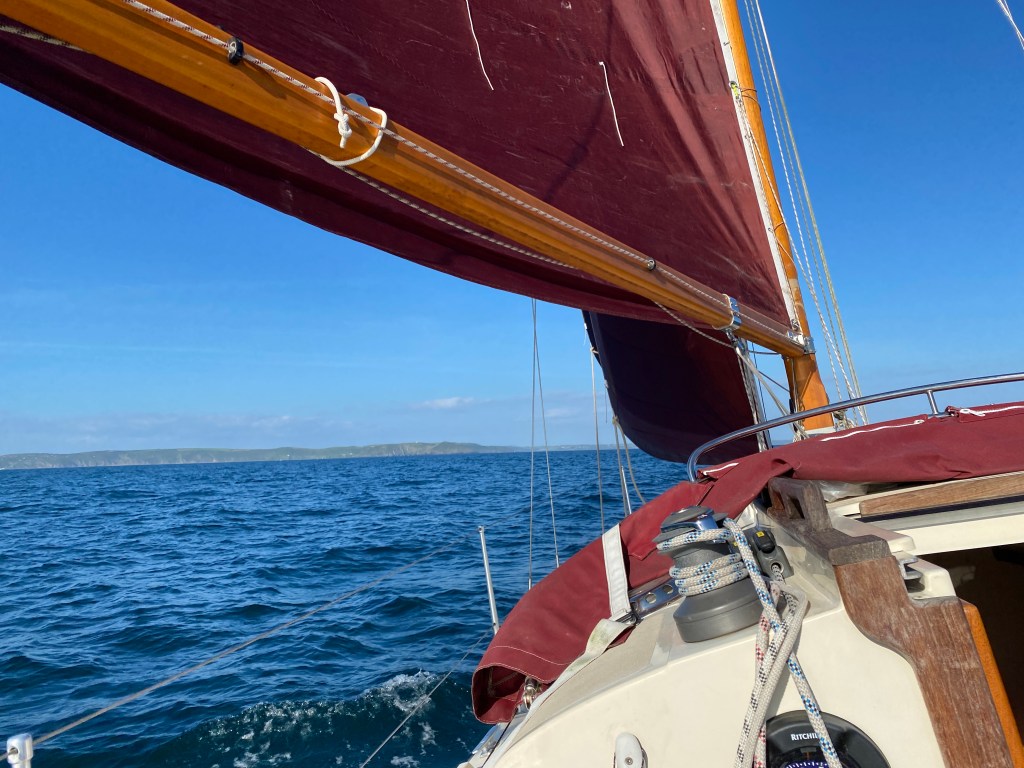
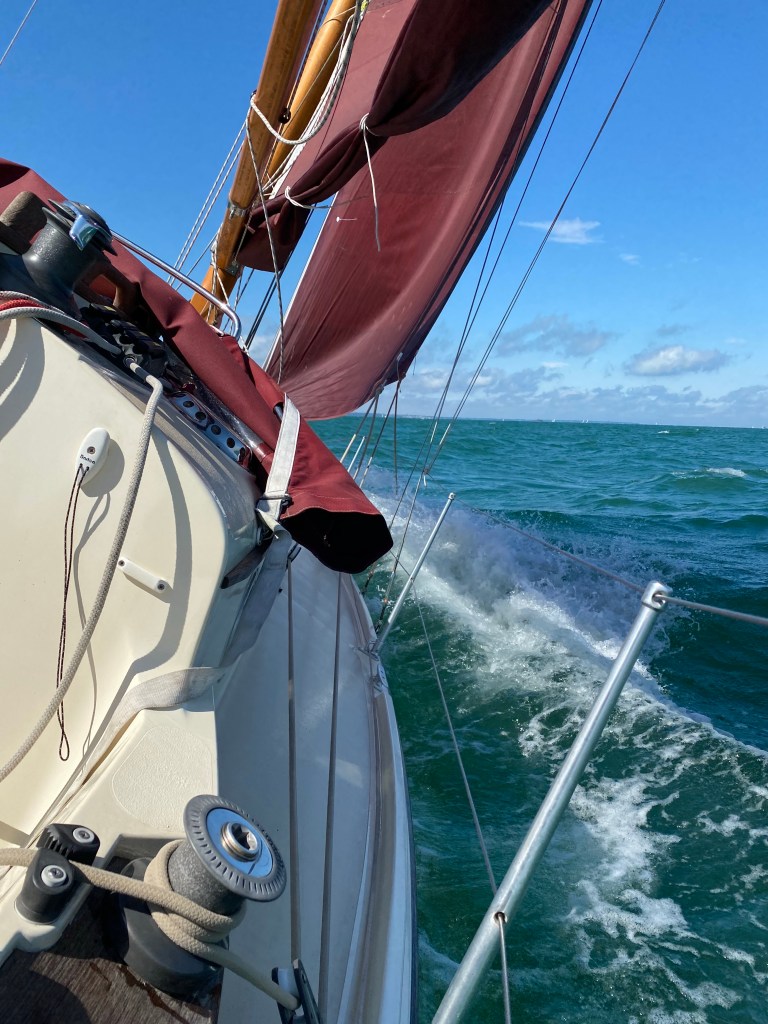
We had a marvellous sail with both jibs and single-reefed main, with Molly cutting confidently through the small waves. We were making 6kt for much of the time and I was expecting an increase in speed when we bore away onto a reach after the fort, but the wind was noticeably lighter in the shelter of the Island.

Alice helmed for most of the sailing and took Molly into the harbour, as I put out the warps and fenders. We made a very efficient return to harbour, dropping main as we turned off the channel towards the club. However, with the water very low, I could not turn Molly to reverse up the fairway to our berth and ended up going in forwards. This means our next adventure begins by going astern…
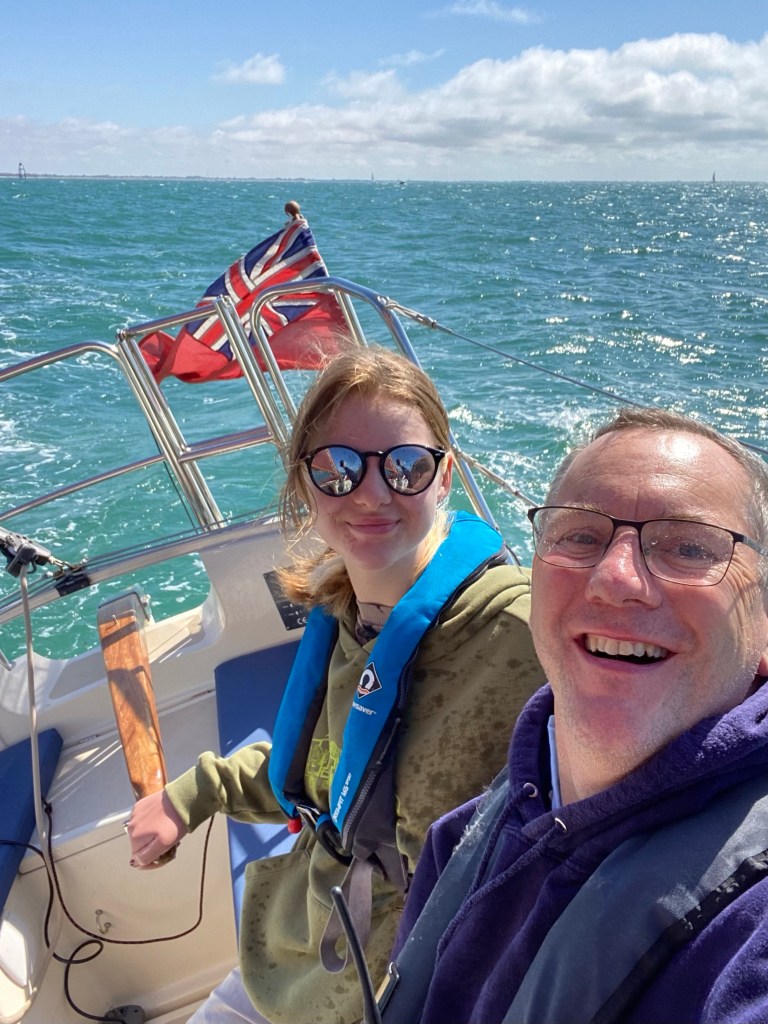
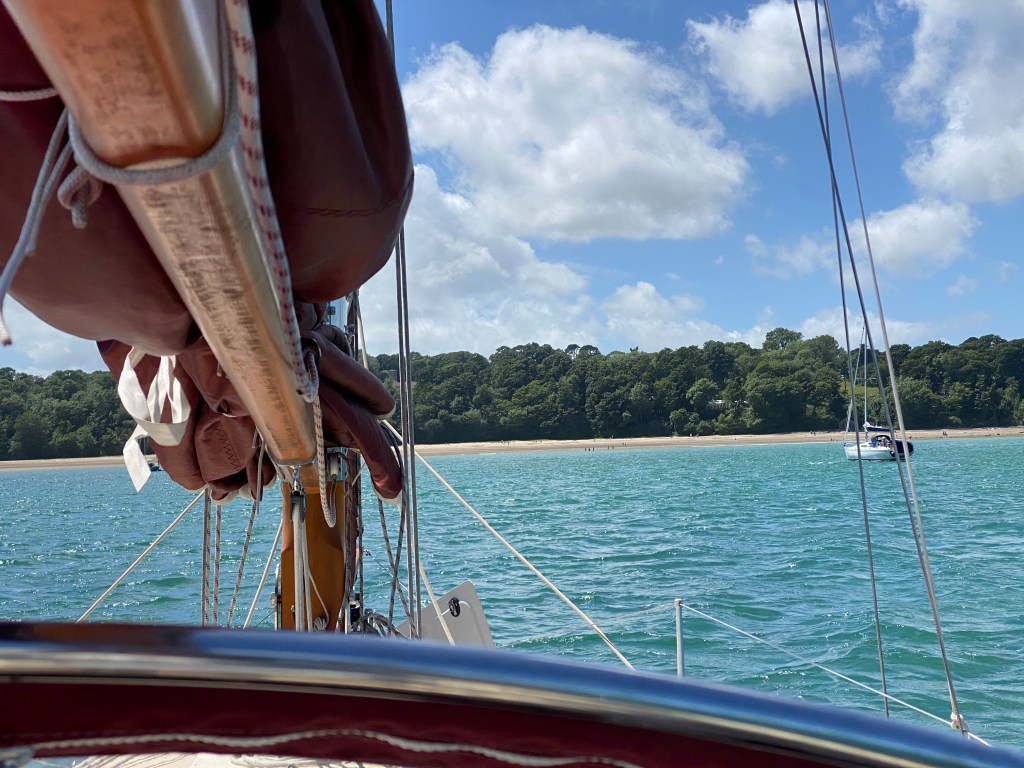
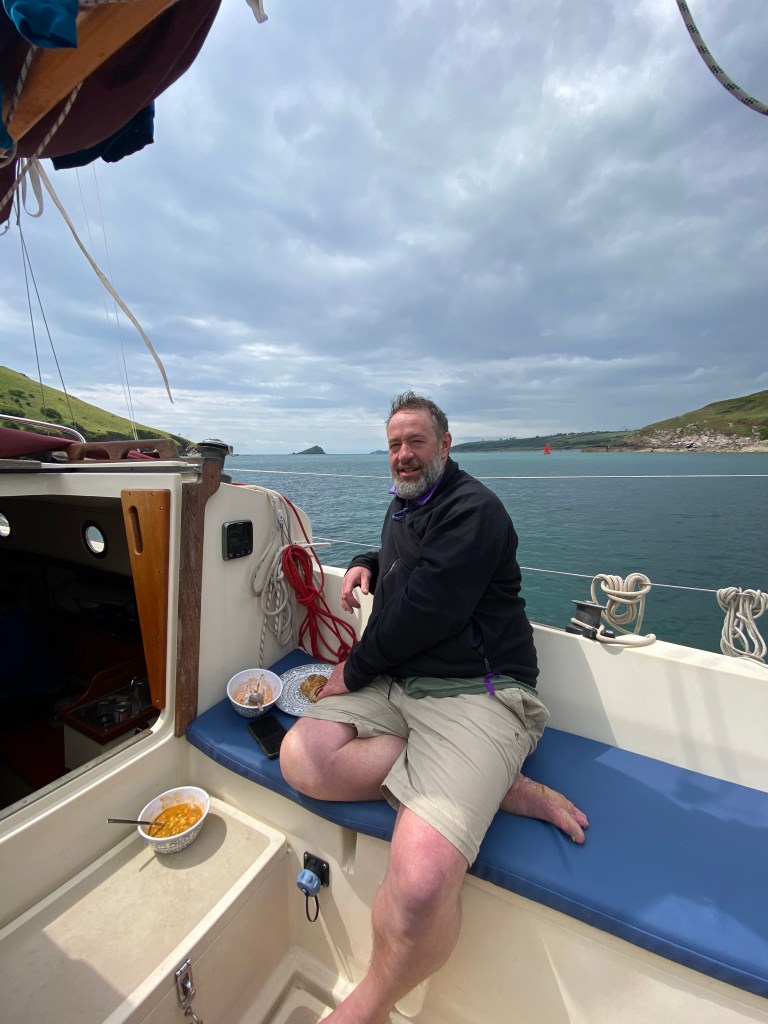
The smiles say it all!

Portsmouth weekend

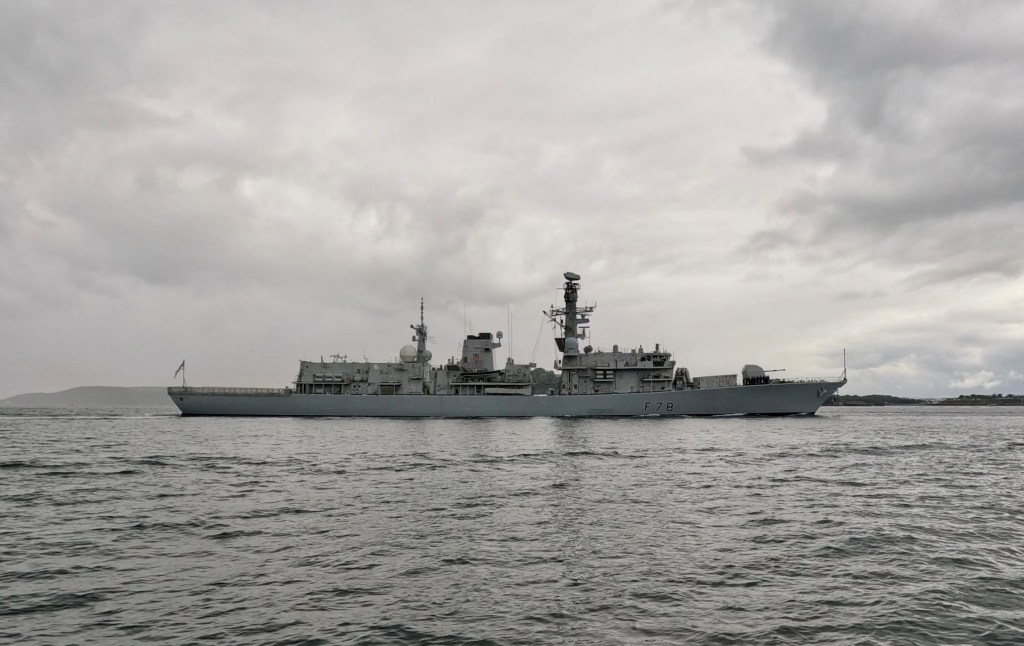
One of the things I love about keeping Molly at our club in Gosport, is that there is so much going on. There are craft of all types and ages to watch, and the traffic through the narrow mouth of Portsmouth harbour is something to behold. This weekend was a typical relaxed couple of days aboard. There are plenty of locations to choose, based on the weather. This weekend there was a strong westerly, so I chose Priory Bay outside Bembridge for anchoring on Saturday, and a beat-run towards Cowes on Sunday. Below is a sample of the traffic I passed.

At anchor in Priory Bay. It doesn’t look busy, but behind me….
…I had a lot of company.
Wind turbine blades on the move
That’s a lot of rock! Cargo laden…
…and unladen
Cornish Crabber 24 in brisk conditions
Hovercraft leaving Ryde
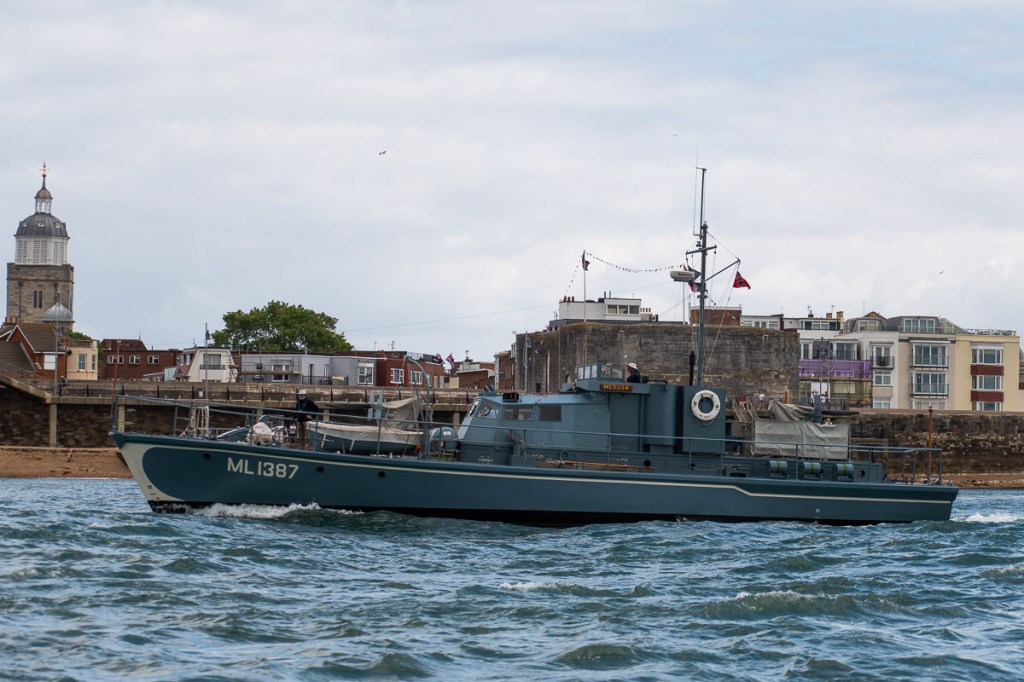
HMS Medusa, wooden WWII harbour defence patrol launch returning to her berth in Gosport
HMS Mersey, offshore patrol vessel, also returning to port
US navy ship leaving Portsmouth

Yarmouth gaffers

Every year, the Solent area OGA holds a rally in the lovely Isle of Wight town of Yarmouth. It’s always an enjoyable weekend and this year, owing to the Platinum Jubilee, it was over four days, instead of the usual three.

My passage back from Falmouth had been timed to be able to attend this rally, so I was glad Ben and I had had no delays sailing Molly to her new home waters. I dropped Ben in Lymington and took the opportunity to re-provision there too, before crossing the Solent again into Yarmouth.

Lymington town quay – rafted three deep

It was great to see attendance up on last year, following the cancellation of the event in 2020 (last year I attended in Aurora, as part of the Cape Cutter 19 rally) and there was a pleasant pontoon drinks party to restore connections from previous years.

The last few long days of sailing caught up with me and I retired to bed early after a delicious steak cooked aboard and a glass or two of red. In the morning I woke refreshed and had a leisurely start before sailing back to Lymington once more to collect Niki, who returned to the boat after a few days at home with Alice.

Molly dressed all over

After eating a rather good paella cooked in our thermal cooker, we repaired to the sailing club for live music and dancing. After a nightcap aboard Molly with the intrepid crew of Miss Ningi, we hit the sack.

Miss Ningi

Saturday morning is always the gaffer race, organised by Royal Solent SC, but sadly the race was cancelled this year, as the wind was too strong.

Royal Solent sailing club

Niki and I elected for a walk and enjoyed a wonderful seven-mile loop to Freshwater Bay on the south of the island. This was an absolute treat, taking in cool woodland, rolling farmland and the marshes along the banks of the river Yar.

Boats on the Yar seen from the lovely wooded footpath along the old railway line

The event was rounded off with prize giving and a BBQ meal; see you all next year!

Into The Solent

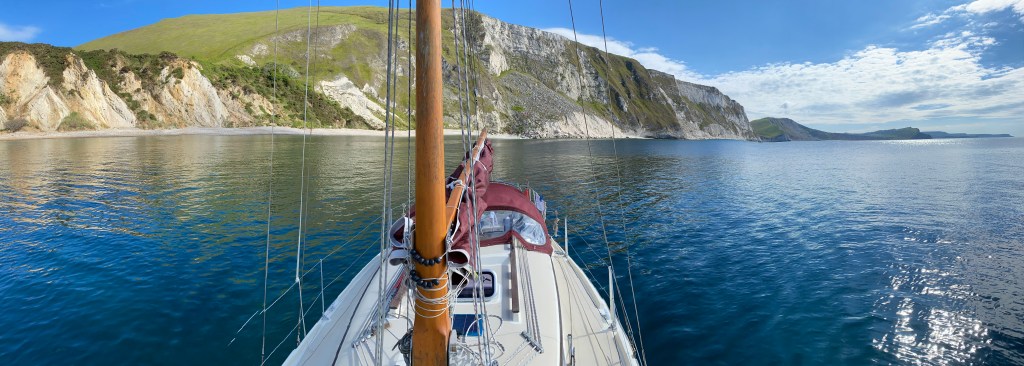
Worbarrow Bay

Wednesday dawned bright and fair. Ben and I had a leisurely breakfast whilst admiring our beautiful anchorage. The anchor alarm showed that we had held firm through the night, which increased my confidence in the holding ability Mr. Spock, our Vulcan anchor, as we had had strong gusts during the night. I wanted to fly my drone, but sadly the anchorage fell within the scope of Lulworth firing range, which prevented takeoff.

Mupe Rocks
Good holding!

Today was expected to be a “no wind” day, but there was a lovely southerly sailing breeze as we lifted anchor and continued our voyage east. With a fair tide under us we passed off St Albans head, turning to follow the coast past Peveril Point, Swanage and finally Old Harry Rocks. The water was very busy with all kinds of pleasure craft, from canoes and small dinghies to large yachts and motor boats, everyone enjoying the sun and sea breeze.

Dorset’s impressive Jurassic coast
Handfast Point and Old Harry Rock
Staysail poles out with a boat hook

At this point, the tide had turned against us, so we angled into Bournemouth Bay to minimise to its adverse effect. There were obvious overfalls at Hengistbury Head, where the ebbing tide was pouring off the shallow water of Christchurch Bay, over a ledge into the deeper water of Bournemouth Bay.

We had time to kill before the tide changed once more and we could enter the Solent. Our hope was to poke our nose into Christchurch h harbour, but it looked like we would be trapped by the falling tide if we had done so. As an alternative, we sailed into the lee of Hengistbury Head and anchored for an hour or so.

The was not a very comfortable experience initially because I had not allowed for the tide. The anchor bit immediately but Molly did not rest head to wind into the waves, but lay almost broadside due to the flow of the tide. I could not believe that just over 0.5kt of tide could beat 15kt of breeze, but the evidence was clear: as the foul tide eased, Molly turned head to wind.

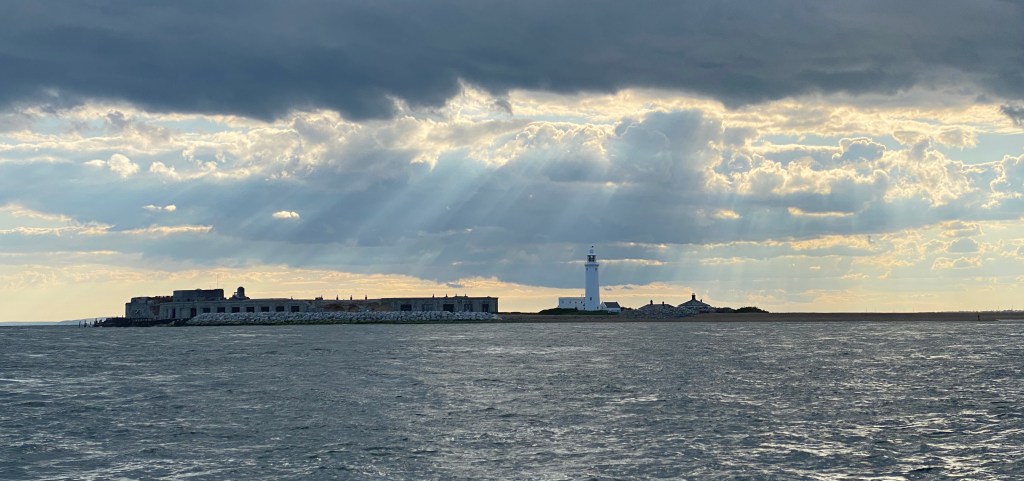
By the time we lifted the anchor, the breeze was a steady F4 SW and we made excellent progress across the bay, keeping fairly close in and shaping our course for North Head buoy. This marked the beginning of our track into the Solent close round Hurst Point. I wanted to show Ben the full effect of Solent tides, he being unused to strong tides in his home waters of Falmouth, but the wind dropped once we were in the shelter of land on both sides and also shifted to dead downwind.

Looking back to Hurst Point

We shook out the reef we had been carrying and moving quickly, despite sailing slowly, soon made Newtown Creek. I had particularly wanted to show Ben this marvellous anchorage; we had a clue how crowded the anchorage would be by the number of boats anchored outside sheltering under the low headland. Crowded through it was, we did not have much trouble finding a place to anchor. Little scope is needed in this shallow water; in fact we had to raise the centreplate within the anchorage.

Sunset at Newtown Creek

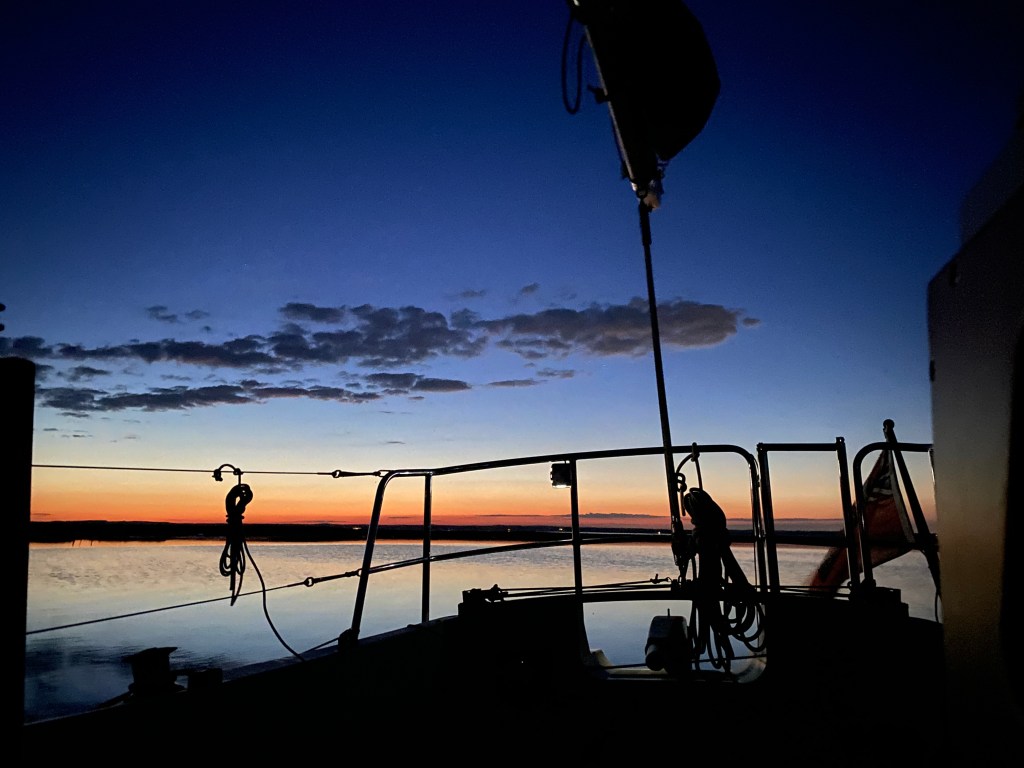
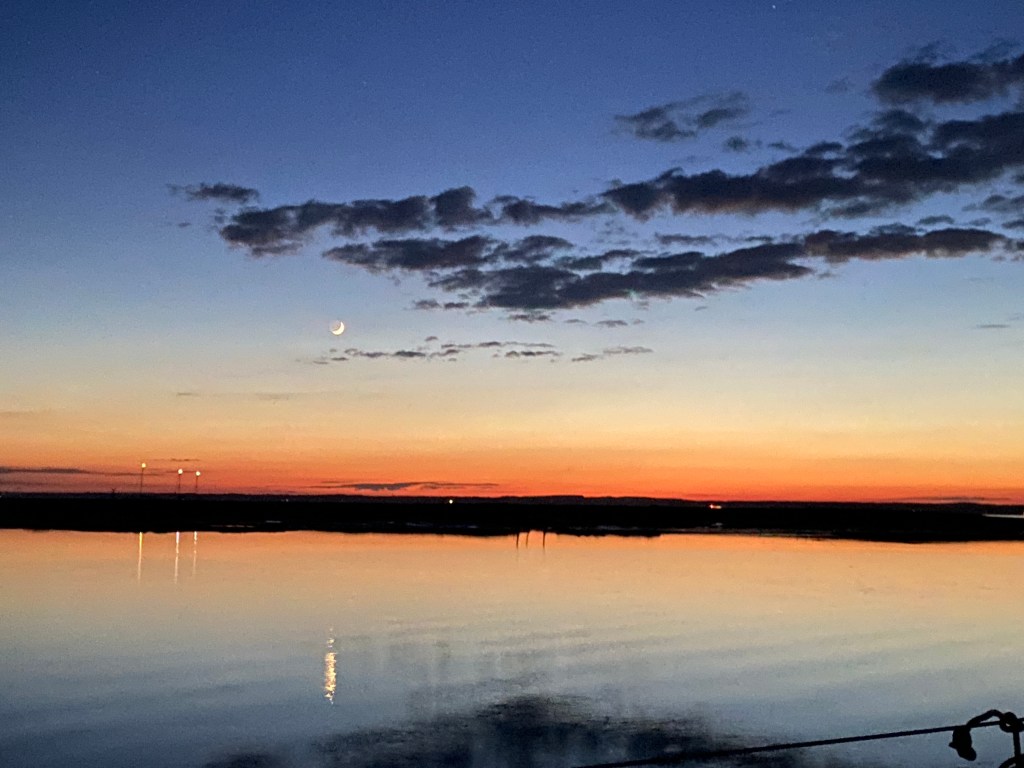
As the sun set, the wind faded and we were treated to a most beautiful sunset and rise of the young crescent moon, to the soundtrack of the calls of oystercatchers, geese and terns.

I was very glad of the oven and had put our tinned pies in as we approached the entrance to the creek, so by the time the tinned vegetables were warmed we had a welcome hot dinner.

We had had an amazing passage, covering almost 40 miles and only using the engine for an hour in total – not bad for a “no wind” day!

Moonrise

Conquering Portland Bill

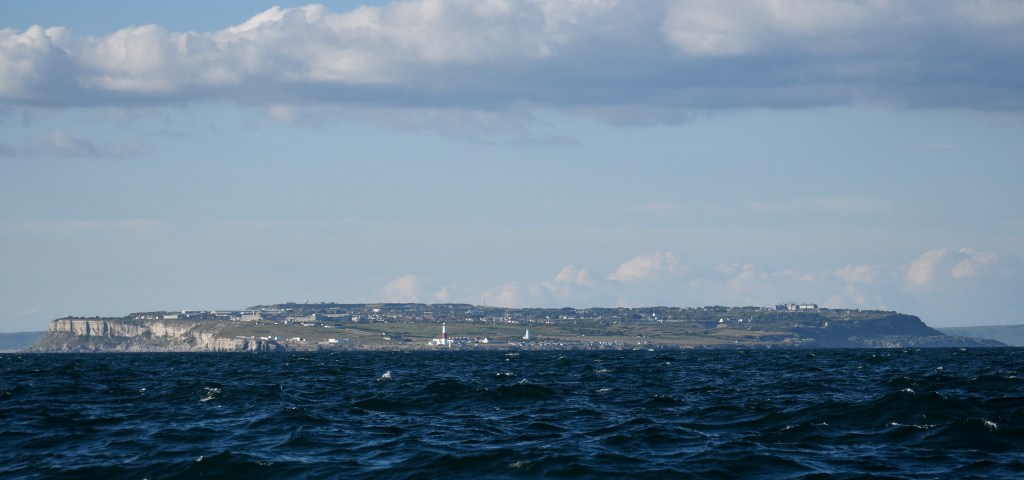
The Bill of Portland

The Bill of Portland is an enormous wedge of eponymous rock sticking out into the channel. The strong tides, overfalls and eddies are very considerable and constitute a significant inconvenience, not to mention hazard to small craft making their way along the coast.

Today was exactly on spring tides, so the currents would be at their strongest and it was important to time our arrival carefully. Travelling east, this is not easy because there is nowhere convenient to wait if one arrives early (as there is when travelling West), but it is also important not to arrive late either.

There is an inshore passage which saves considerable distance, but I considered it too risky for my first passage and on springs. So that dictated that we should pass at least 3nm off, arriving at 6pm, at the turn of the tide when the overfalls were least and then take advantage of a fair tide into Weymouth bay.

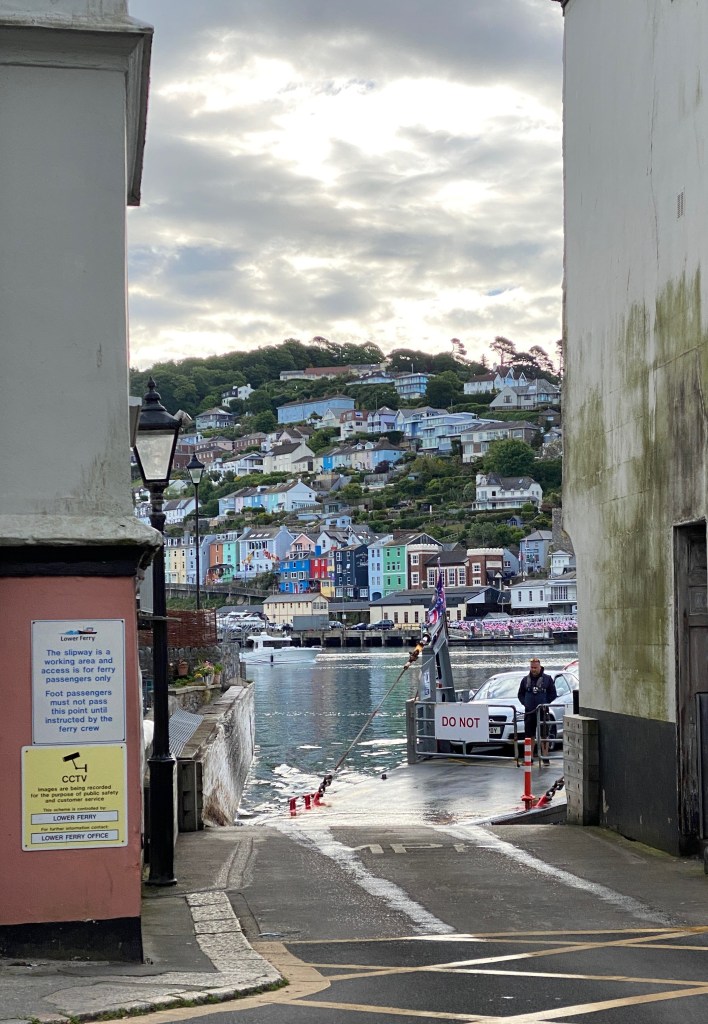
The ferry which runs between Dartmouth and Kingswear
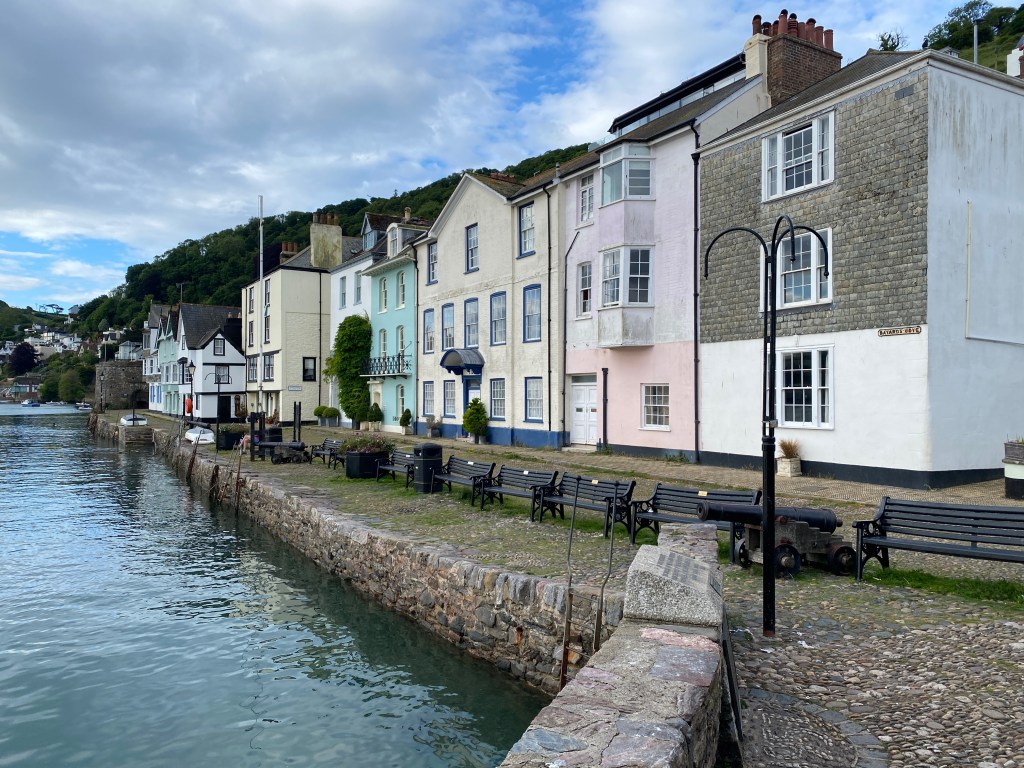
Bayards Cove, where the Mayflower and Speedwell first set off for America, before being forced to return to Plymouth for repairs to the leaking Speedwell

We took an early morning stroll around Dartmouth town, a lovely place with a lot of character and history, before taking on some provisions and departing. The provisions took the form of more pasties, in fact double rations as both Ben and I both bought some. These were definitely Devonish Pasties (as opposed to Cornish pasties) with their wacky flaky pastry!

Devonish Pasty
Offshore passage. Note Andy “the arm” Autohelm is wearing his plastic raincoat.

Our track was due East, passing the line of rocks outside Dartmouth and then opening Torbay as we left Berry Head behind. We had main up but there was little wind. As we moved further offshore, towards the invisible Portland Bill, the wind gradually filled in, to give a good training run. However the wind shifted gradually, until we were dead downwind and the jibs were not pulling.

Our track for this passage. The red dot lower right was the centre of the 6nm circle of live firing. At this scale, the chart shows The Shambles as an oval to the east of Portland

We could hear on the VHF two ships warning of live firing. “Warship Westminster” was no concern, being far to the east, but RFA Cardigan Bay was reporting a 6nm radius of live fire in our track.

This forced us to gybe in order to stay on a track which maintained our minimum 3nm offing from Portland, whilst staying out of the radius reported.

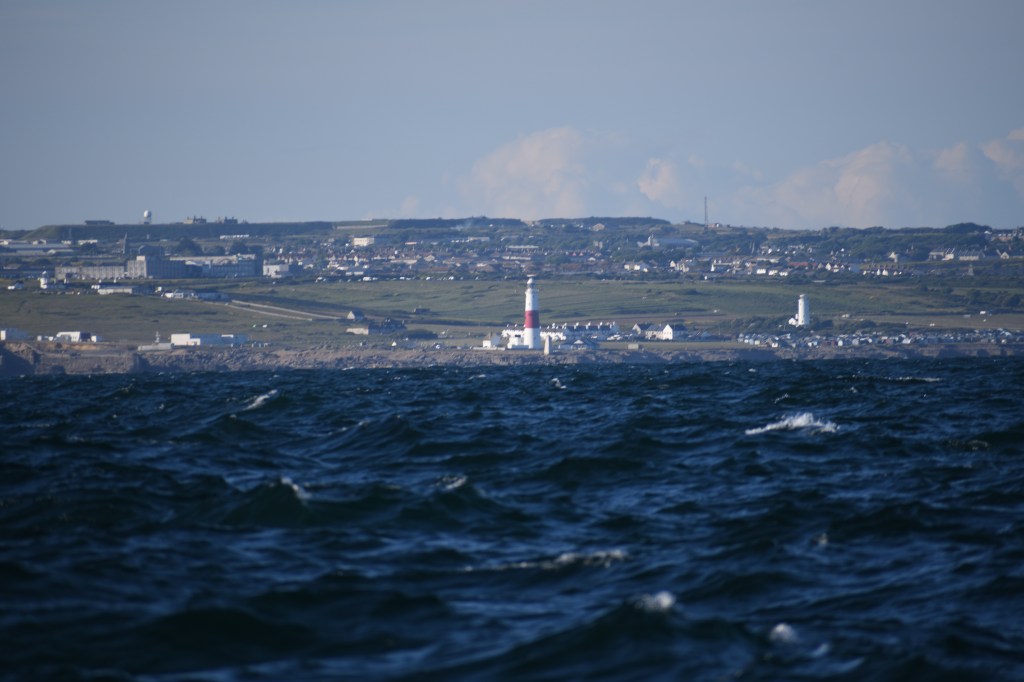
Portland light due North

In the end, the wind strength was too high for main only and we took it down (not easy in the big rollers that were forming) because the helm was too heavy without the balance of a jib sail, which weren’t setting as we were dead downwind. We continued on engine and jib and watched the enormously long wedge of cheese that is Portland Bill take on form and colour as we approached. The tide was against us; progress was slow and we reached the watershed of directly south of Portland Light at 1900. From then on, the tide built in our favour and we were soon skimming along outside Shambles Bank at over 8kt in a joyous reach.

We had decided to try the new anchor in Worbarrow Bay, at Mupe Rocks, where we would be sheltered from the SW breeze. The forecast was for the wind to drop to nothing overnight, so we were not too worried about the swell. The sun was setting as we closed the land, but we made a very efficient main sail drop in time to drop anchor, tucked into the lee of the rocks and shielded by the magnificent chalk cliffs, before twilight faded.

Whoosh!
Fast reach at sunset

Ben and I ate our second pasty of the day with a well-earned glass of beer before retiring to bed. I set an anchor alarm, but I was confident in “Mr Spock” (our Vulcan) – Molly came to a full stop when we had motored full astern during our anchor setting. In any case, the forecast was for the wind to disappear almost completely for the next 24 hours. Well, it did not turn out that way! The wind rose and backed to NW, which gave us the full shelter of the cliffs we were under, and Molly held her ground perfectly as she swung to the shifts and strong gusts. A resounding win for the new anchor! I woke in the night to poke my head out and was greeted by the most fabulously clear star-filled sky. I was too tired to admire it for more than a few moments before returning gratefully to my warm berth.

Starry night at Mupe Bay

Dartmouth

We had an early start and made full use of the excellent facilities at Sutton Marina in Plymouth. Niki left us for the train back to Falmouth, pausing in Plymouth again on her way back for brunch with Aimee, who was in the midst of her uni exams, before driving home. Our passage plan was to move Molly another good hop towards her new home, and make for Dartmouth.

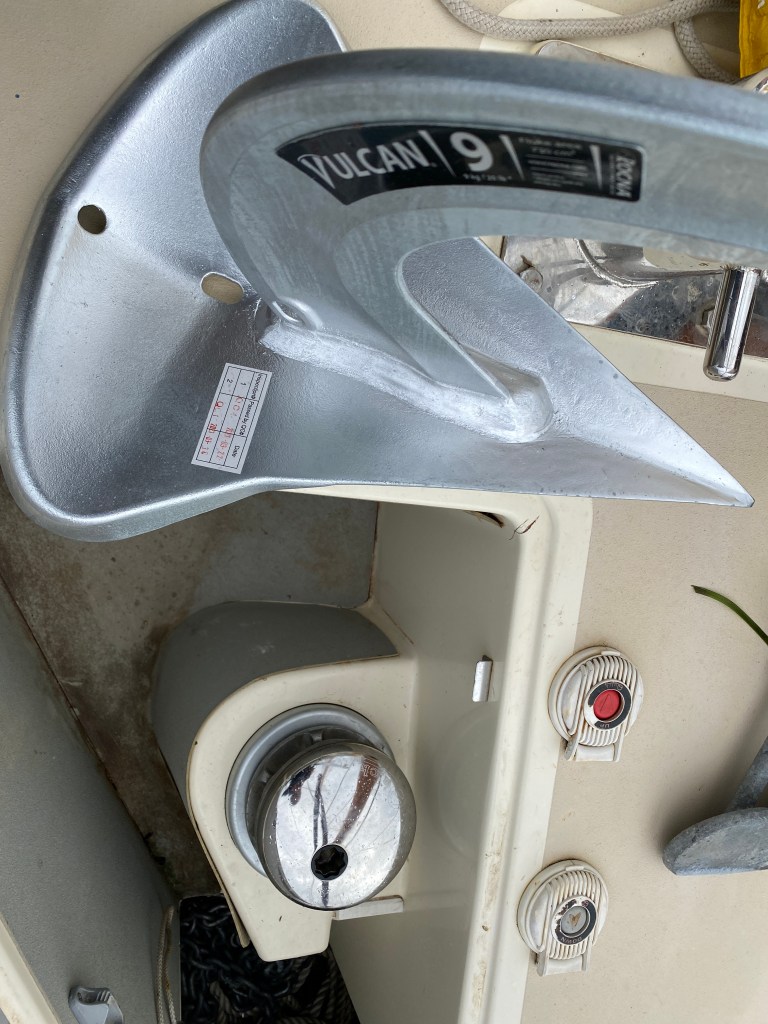
My main order of the day, following yesterday’s experience was to replace my anchor for something more grippy before departing. After reading around, the ground tackle of choice seemed to be either a Rocna or its later development, the slightly more compact Vulcan. It was reassuring to know that not only had others testified to its holding but importantly also reported that it fitted the anchor locker of the Crabber 26.

Plymouth ought to be a good place to procure boat equipment, but most of the chandleries didn’t have my anchor of choice. Fortunately the excellent chandlery at Mountbatten had a 9kg Vulcan in stock, so Ben and I took the foot ferry across the harbour. Pausing only to restock with pasties for our voyage, we returned to Molly and fitted her shiny new pin, made our way through the lock and motored out into the sound.

Anchor well and prosper! Mr Spock, the 9kg Vulcan

Just as we were hoisting the main, a military RIB asked us to move out of the channel, and moments later the frigate HMS Kent came steaming up the East channel at speed.

HMS Kent

Although we had the main up, it was not working at all and it was not a very peaceful passage down the Devon coast; although there was little swell, the sea felt confused without the drive of the sails and gave us an uncomfortable motion. We passed by some of my favourite diving sites at Hilsea point and the Persier wreck in Bigbury Bay, where we could see the mouths of the Erme and Avon from afar. I thought, not for the first time, that I wished there was time to explore these places.

Eventually Molly passed Bolt Tail and we travelled along that forbidding four miles of cliff, until we reached Bolt Head and the entrance to Salcombe. We had discussed this as an alternative place to overnight, but Ben and I both agreed we should carry on.

The sea was much flatter now and a fair tide was increasing; we quickly passed Prawle Point and approached the prominent outcrop of Start Point with its conspicuous lighthouse. By this time we were scooting along at over 7kt and were rapidly covering the remaining ground.

Rain approaching

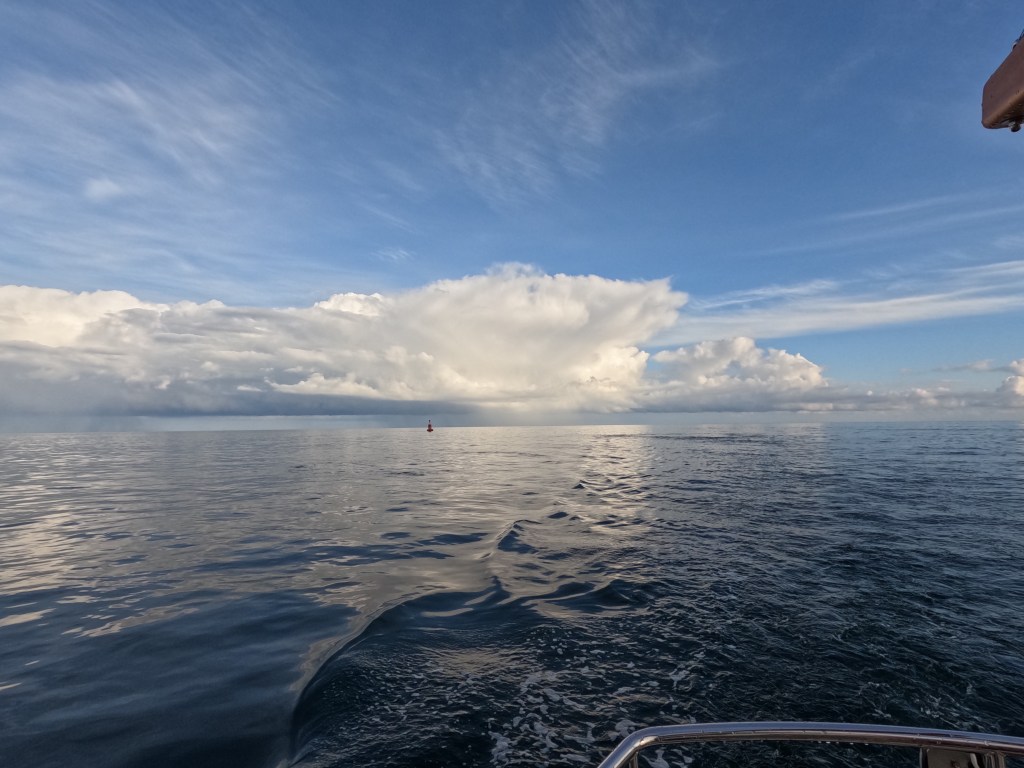
We were treated to some spectacular meteorology, with banks of dark grey cumulus approaching. We could see a lovely pilot cutter in the distance turning across our track. The heavens opened and a massive downpour began with the rain cascading down onto glassy water. It was so quiet that could the strange hiss of the drops on the surface of the sea as we sped along. We watched the pilot cutter pass in front of us and follow the shore of Start Bay; we took a route outside the Skerries Bank, though there the only evidence of overfalls were occasional patches of boiling water on the glassy water surface.

Hetty entering Start Bay

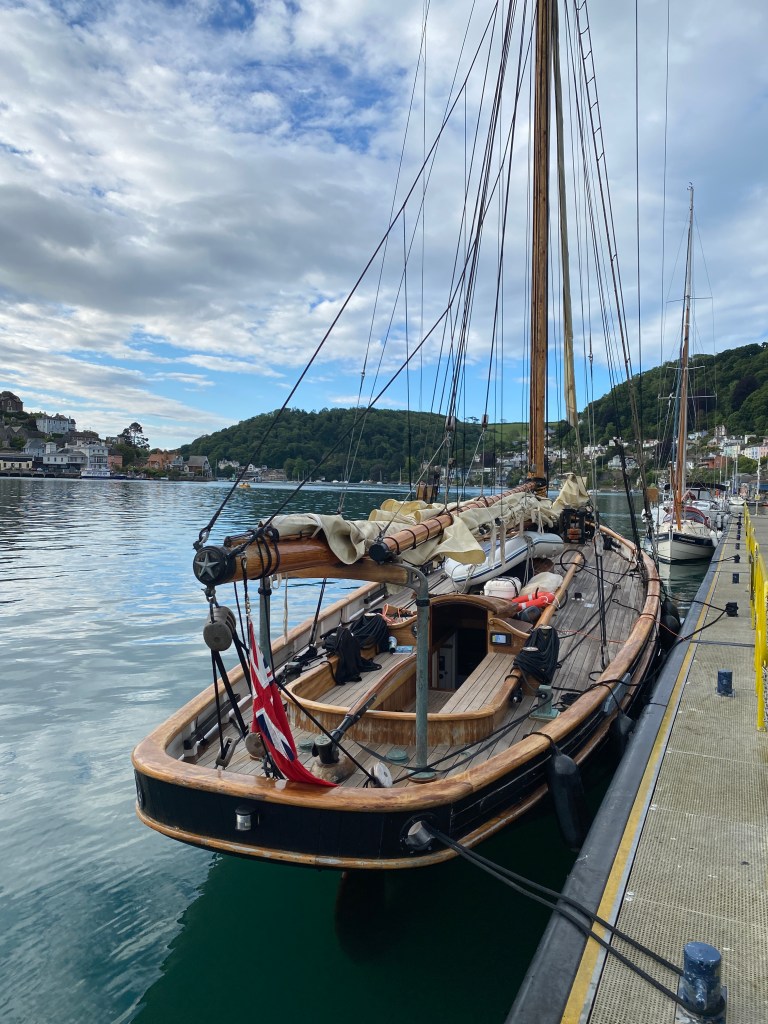
The cloud passed away as we entered the mouth of Dart River and Ben and I were treated to the sight of Dartmouth and Kingswear in the early evening sun. We treated ourselves to a berth on the town quay, ready for some well-earned fish and chips. It was only when we were tied up that I noticed that as this was the ferry quay, we needed to be away by 0845 the following morning. The helpful harbour master pointed out that we were welcome to move to one of the pontoon berths in the morning if we wished, so we decided to stay put.

We were joined just after by the gaffer we had seen in the bay, which turned out to be Hetty, a 1906 pilot cutter, who was travelling in the opposite direction to us, from Weymouth on her way to Cornwall for a pilot cutter rally.

Hetty alongside in Dartmouth

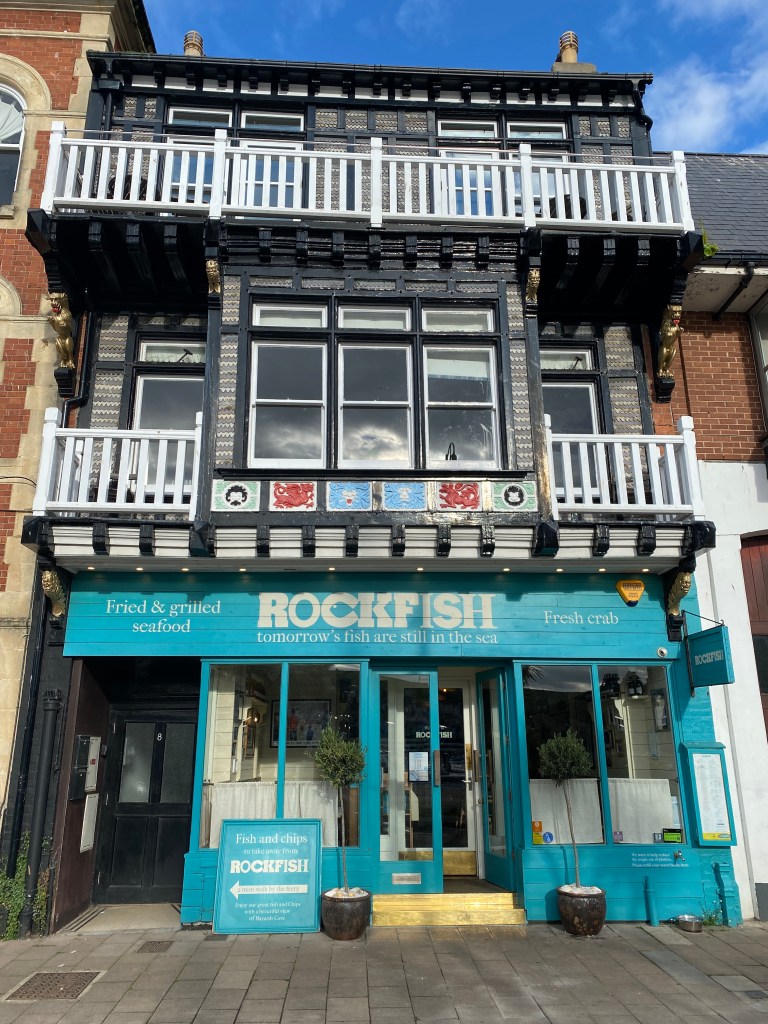
We enjoyed Rockfish fillet and chips aboard Molly with the fine Shropshire bitter I had brought with me from home. The meal was provided by the chip shop of the same name and was excellent.

We spent the rest of the evening discussing our next move. The wind had been favourable but very light for the past several days. We had one more day of favourable wind forecast, followed by a day of no wind and then adverse winds. The forecasts had not been accurate, but I really did want to end the week with Molly on her berth in Gosport and I also did not want to plod upwind on the motor if I could avoid it.

Ben and I considered many options, but in the end decided that we’d make an early start in the morning, pass off well off Portland with a favourable spring tide in the early evening and see where we got to, with the option of going overnight all the way into the Solent or, more likely, anchoring somewhere before Swanage to avoid sailing through the whole night and allowing us to time our Solent entrance to a fair tide.

Excellent fish and chips!

Anchor angst and the Yealm

We were anchored off the beach at Cawsand. I’ve never been ashore at Cawsand, so the plan was to inflate the dinghy and explore the twin villages of Kingsand and Cawsand. Niki said “are you sure it’s safe for us to all go ashore?” Prophetic words. “It’ll be ok”, I judged.

“Anchored” in Cawsand Bay

There was a gentle onshore breeze and the three of us landed easily in the tender. The villages, separated by only a few yards, but which historically had been at loggerheads for many years, were indeed lovely, especially with the decorations up for the queen’s Platinum Jubilee.

Narrow streets with jubilee decorations in Kingsand

At several points we could see Molly from afar and observed that she was still in position. As we walked along the shore, Niki said “I’m sure she’s moved”. We quickened our pace. By the time we had regained the dinghy, it was clear that the wind had increased to about F4 and Molly was dragging.

Is she dragging ?

The waves on the shore were not so easy to negotiate as our arrival and it was a much more strenuous row. We agreed that as soon as we reached Molly, I would go to the bow and Ben would start the engine, whilst niki remained in the dinghy. There were a scant few metres between Molly and the shore when the engine was engaged, but the anchor was soon recovered and the only casualty was poor Niki, who not only had a good soaking in the dinghy but cut her hand into the bargain.

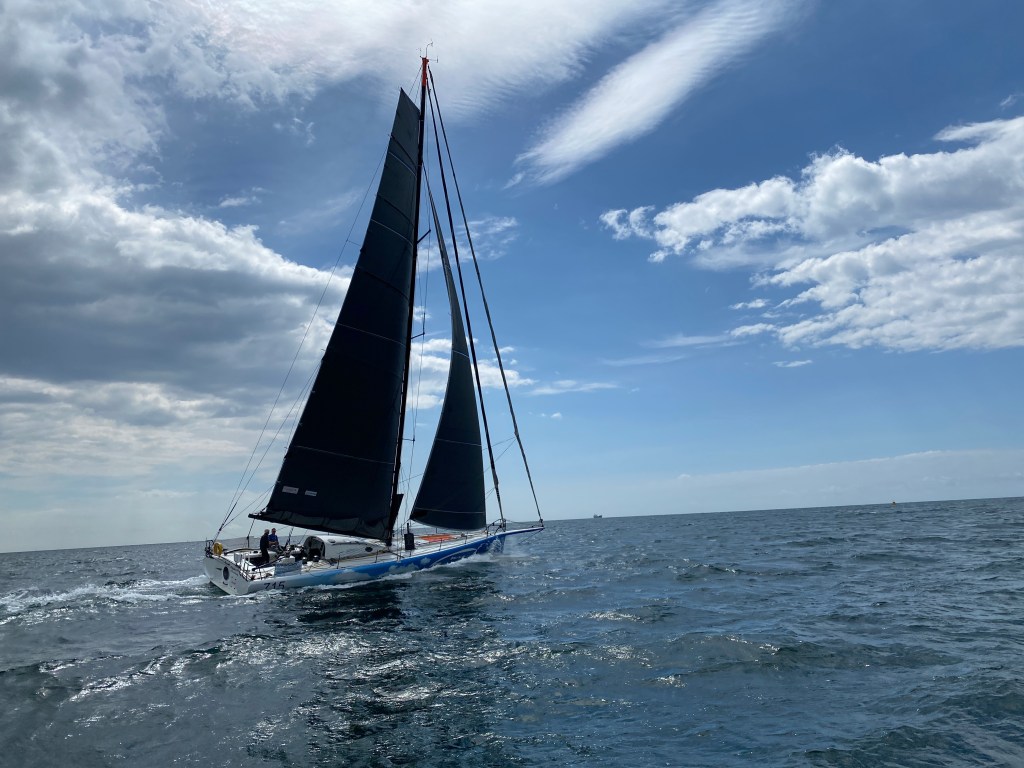
Niki retired below to warm up under a blanket , whilst Ben and I motored across Plymouth Sound. It was slow going, dead into the wind and we also had to contend with crossing the track of a magnificent fleet of flying offshore racers heading for Galway and thence Shetland.

Eventually we reached our planned lunch stop and dropped the plough anchor for the last time in Cellar Bay at the mouth of the Yealm. By this time I had very much decided that my plan to eventually replace it should be brought forward to a status of immediate.

Lunch in Cellar Bay at the mouth of the Yealm

We enjoyed a pleasant lunch and siesta before hosting Dermot, our friend and fellow Crabber 26 owner, who lives nearby and sailed out to see us in his Drascombe Dabber. Sadly rain prompted him to return home but we elected to motor up the Yealm despite the steady rain. It’s a most beautiful spot, even in the downpour. We motored up to Noss Mayo, though we didn’t stop for a pint!

Our return to plymouth sound was another motor session, after we had motored into a strong wind all the way to the Yealm, there was no breeze at all for our return. After that plod, we were happy to arrive at Sutton Marina. We enjoyed a meal of Morroccan Lamb with butternut squash, which Niki had prepared earlier and cooked in our Thermal Cooker.

Plymouth ho!

The first day of our journey East dawned bright and sunny. I moved Molly off her mooring in Mylor for the last time; the majority of our gear was stored in Russell’s van overnight, so the first order of the day was to fetch and stow the provisions. Meanwhile, Ben and Niki procured pasties in Falmouth and I picked them up from Custom House Quay.

Molly and Lucy at Mylor

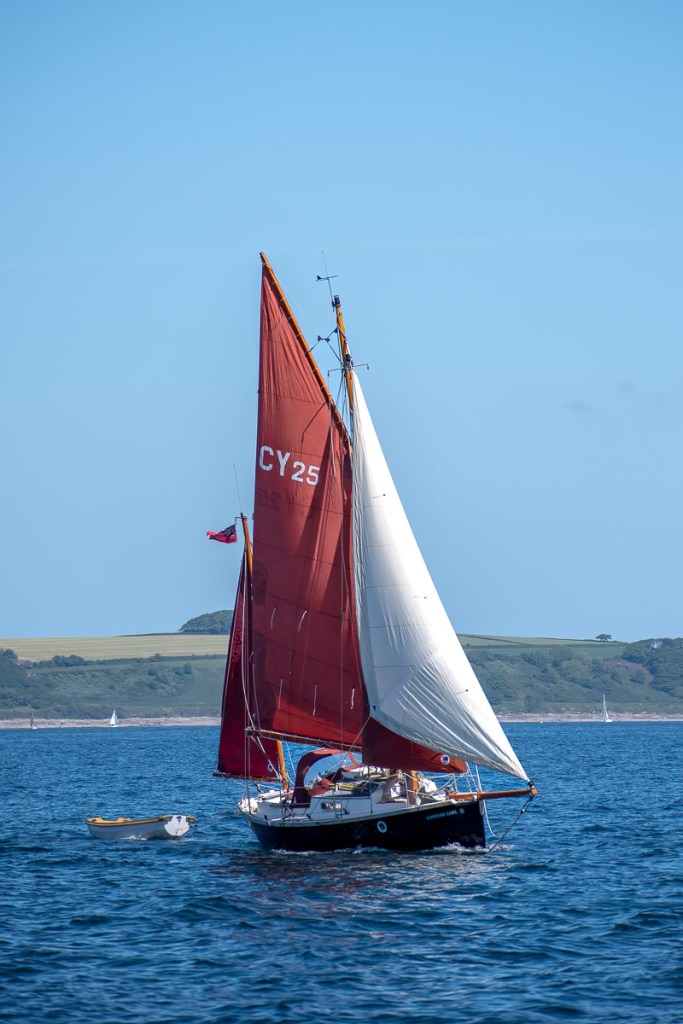
The forecast was for very light and variable winds, but in general from the north. This turned out to be only partly true. I was expecting most of the passage to be motoring, but as we set off there was a light wind from the NE so we sailed out into Falmouth bay, accompanied by Russell in his Cornish Yawl, Lucy. With sufficient offing, tacked to follow the shore a mile of so off. As we watched this Cornish coast slip past, we were very happy to see the wind gradually veer to a SE, allowing us to adjust our course to make it past our first significant headland, The Dodman.

The wind dropped somewhat and so, not long before the Dodman, we fired up the engine and motored across a flat blue sea with our sails little more than decoration. After about three hours of motoring, the wind had filled to the point we were able to silence the motor and enjoy a blissful sail in the sun right up to Plymouth sound.

I have not been confident in the holding of our 12kg plough anchor, standard equipment on the Crabber, so we laid the anchor with some care in Cawsand bay. When we motored astern to dig the anchor in, there was little resistance from our ground tackle. Perhaps the anchor had landed upside down; we tried again and convinced ourselves that the anchor had dug in. The winds were light and we had lots of scope out.

We shared a lovely meal aboard, which Niki had brought pre-prepared and frozen, helping to chill the coolbox, and retired to bed early. However, the peace was shattered at about midnight by the anchor alarm. Ben and I considered our position: it was pitch dark, though we knew there were some moorings nearby, past other anchored boats. The wind had shifted to offshore and was not strong. We had not moved relative to our anchorage companions and also it was low water, so there was maximum scope.

In the end, our decision was to increase the radius of the anchor alarm and go back to bed. If we were dragging, then the alarm would wake us and we would be moving offshore. This proved to work out for us and the rest of the night passed uneventfully.

Lucy in fine trim

Molly moving home

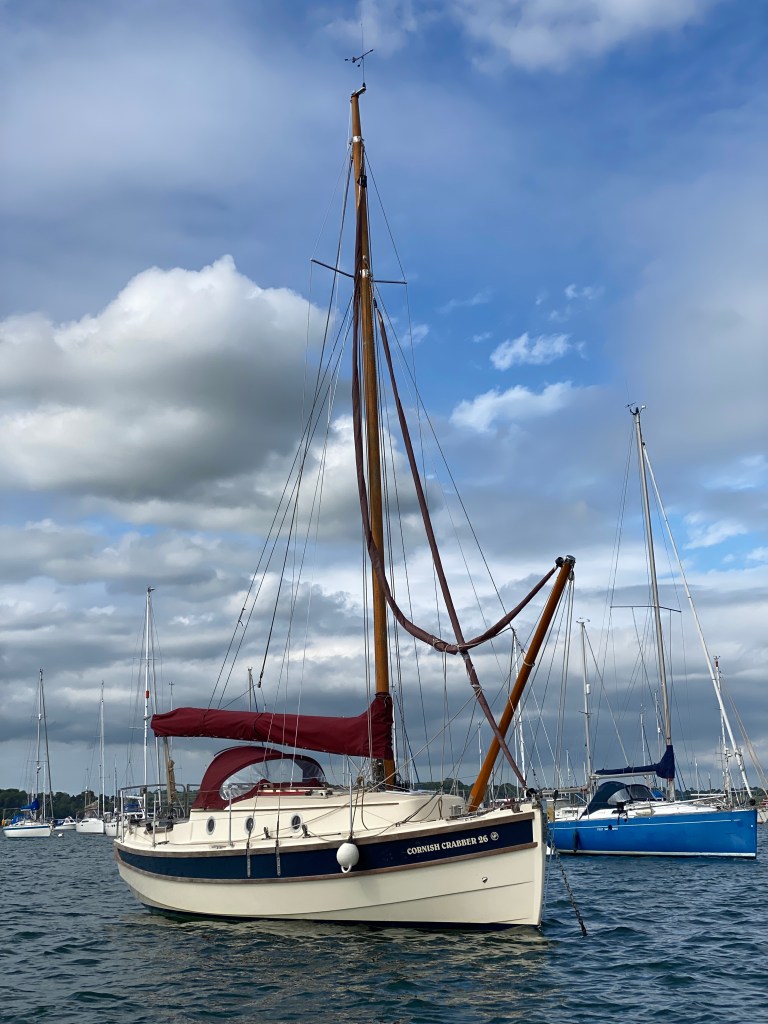
Molly on her mooring at Mylor

I write this on a Friday having arrived at Mylor after a dash down the M5 after work. Molly has been on the Fal since she was launched in 2016 and we’ve enjoyed exploring this lovely corner of Cornwall since we took her over at the beginning of the year.

We’ve had time to get to know how to handle her and use all the systems; this week she will be moving East to her new home waters at Gosport on the Solent. I’m hoping our passage east will allow us to visit some new places, which we won’t be able to access so easily from the Solent.

Sailing in Falmouth bay
Visiting the Helford

Pontoon party

It has been very pleasant to spend some time with old friend and fellow sailor, Ben. We hatched a bank holiday sailing trip with two boats in company, his three sons and their dog, but the weather was rather cold and windy for much beach fun, so sailed up the Fal to Turnaware for a pontoon party.

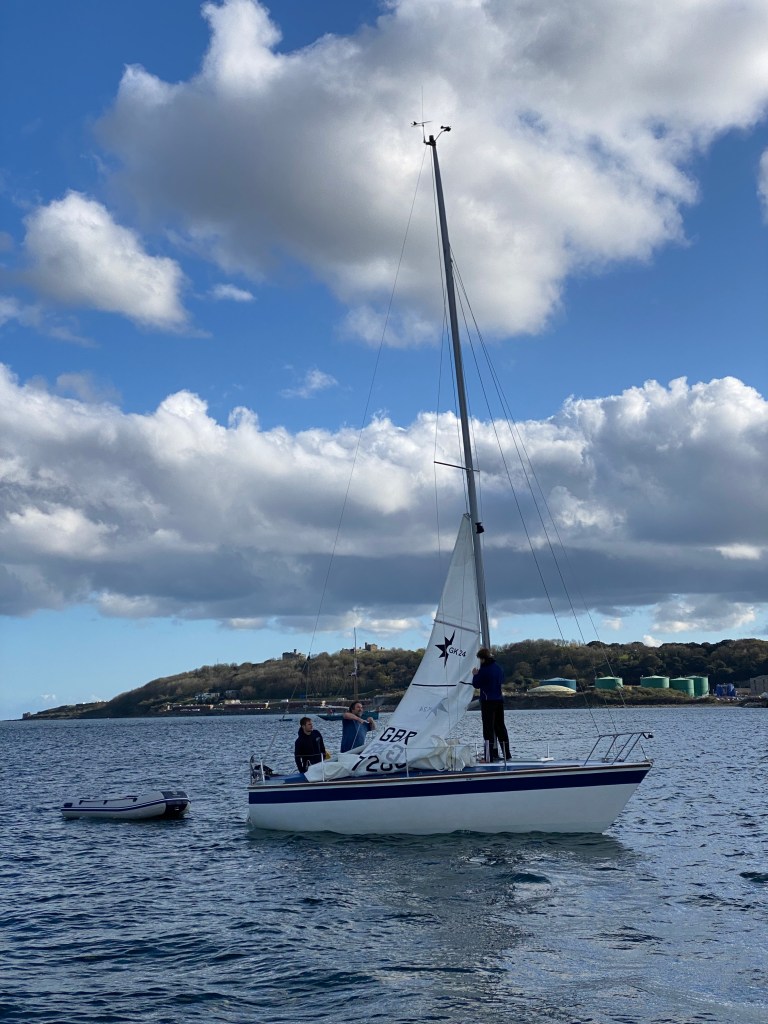
Gulf Kilo, a Westerly GK24 which has been in use by Ben’s family for many years

The original plan was for a barbecue but the weather hadn’t seemed good enough for that, though it was very sheltered at Turnaware and we had a lovely burst of sun as it set behind the oak trees that line the river bank.

The eldest two boys took the dinghy ashore to walk the dog, whilst we cooked aboard Molly. It was a lovely evening and the first time we’d had more than two eat aboard. The galley and saloon were more than adequate for the five of us, and we had a comfortable and sociable time on what would have been a rather chilly evening.

Five for dinner
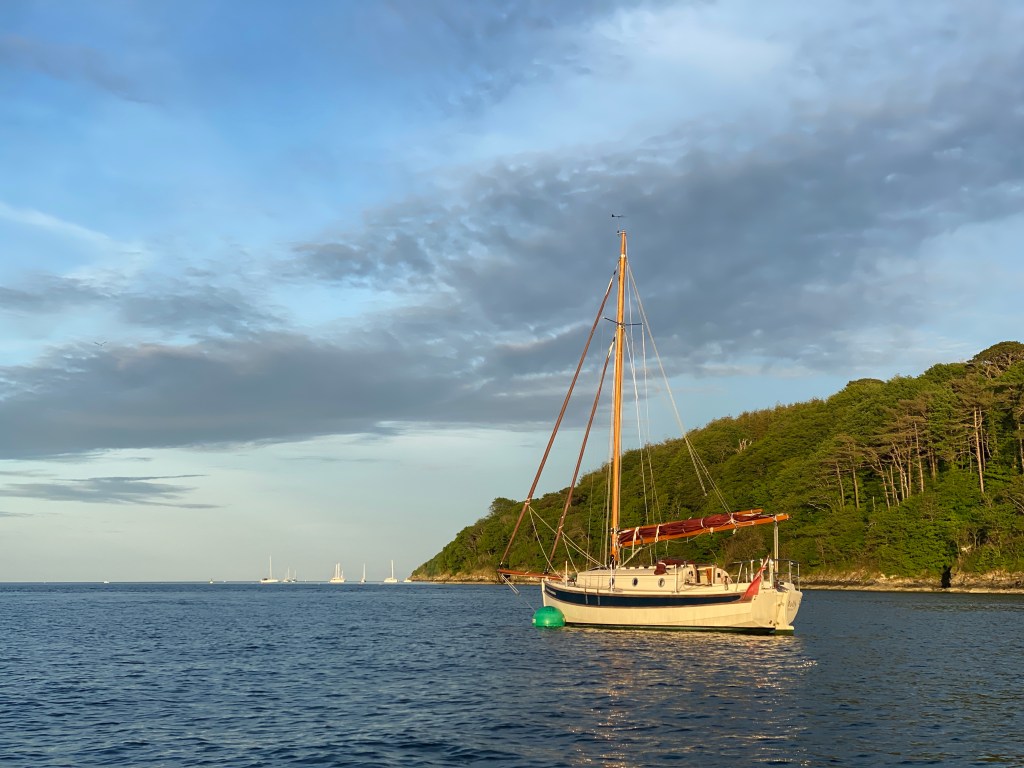
Turnaware in the evening sun