I enjoy anchoring overnight- one of the pleasures of boating is to find out of the way places and enjoy some peace and quiet. However, in the back of my mind, there is always some concern about whether the anchor will hold, particularly at the turn of the tide, and this can make one’s sleep rather light.
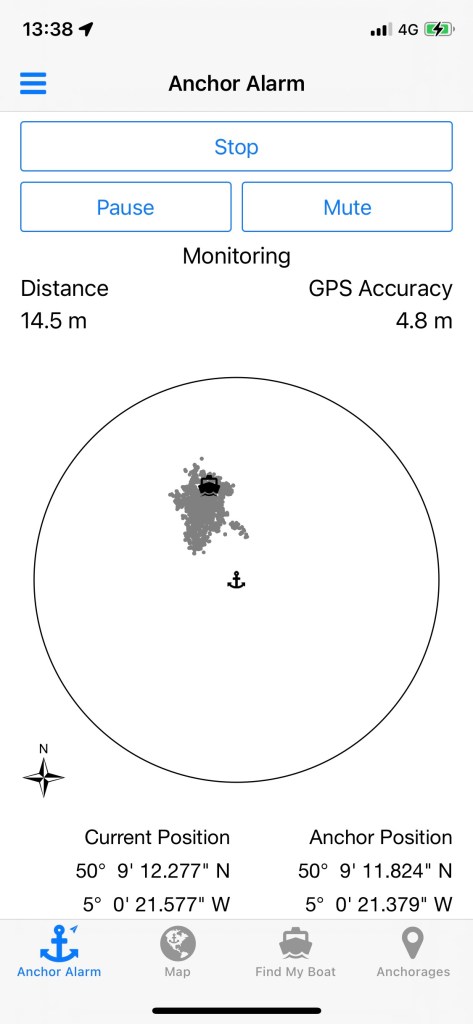
I was always confident in the holding of the rocna-style anchor on our previous boat. Aurora, but the holding of Molly’s pin is unknown to me. I have been using an app called Anchor Alarm to monitor my position. Particularly useful at night, it will alarm if the boat moves out of a predetermined circle. I usually test this by leaving the anchor alarm active when lifting, to check it does the job. I also leave the phone connected to power overnight, as the GPS has a tendency to drain the phone battery.
There are many such apps to choose from, but the features i was looking for are the ability to set the anchor position after dropping the pin (I’m too busy at the time!); to allow for anchoring depth and scope; the app must be able to work in the background, so I can use my phone for other things and finally, some form of graphical display of the boat’s position over time is useful.
After some research, I found Anchor Alarm fulfils all of these criteria. It’s not free and it doesn’t have the ability to remotely monitor the boat position (ie if you go ashore whilst anchored), but I felt I didn’t need that feature. The display is simple and clear and most importantly, it provided me with a sound night’s sleep!
Edit: A few days after writing this, I anchored in St Mawes and the anchor dragged. I think it was due to an improper set of the anchor and/or not enough scope. In any case, the anchor alarm earned its fee because it went off when I was down below and gave me time to start the engine and lift the anchor before we dragged onto another boat.
Left on my own, I decided to revisit an old haunt up the Helford river to try anchoring overnight. I’d not sailed Molly solo yet and was also not confident about being able to reef. However, the light winds provided ideal conditions to try things out – the auto helm makes everything straightforward, freeing me up to pull the string. In fact I very much enjoyed the sensation of the boat helming herself and me able to look around, move about the boat and make adjustments without going off course. I know all this is old hat, but it’s new to me!
I had a most pleasant sail across Falmouth Bay, towards Manacle Reef on full main and staysail. As the wind increased from F1 to F2, increasing weatherhelm was evident, but I decided not use the jib until I had a bit more experience handling the boat and neither was I able to get the reefing to work yet. I did not make a good job of tacking on this trip, and I kept finding myself in irons (presumably not helped by the weather helm – that’s my excuse, and I’m sticking to it) and the boat kept losing way in the light airs.
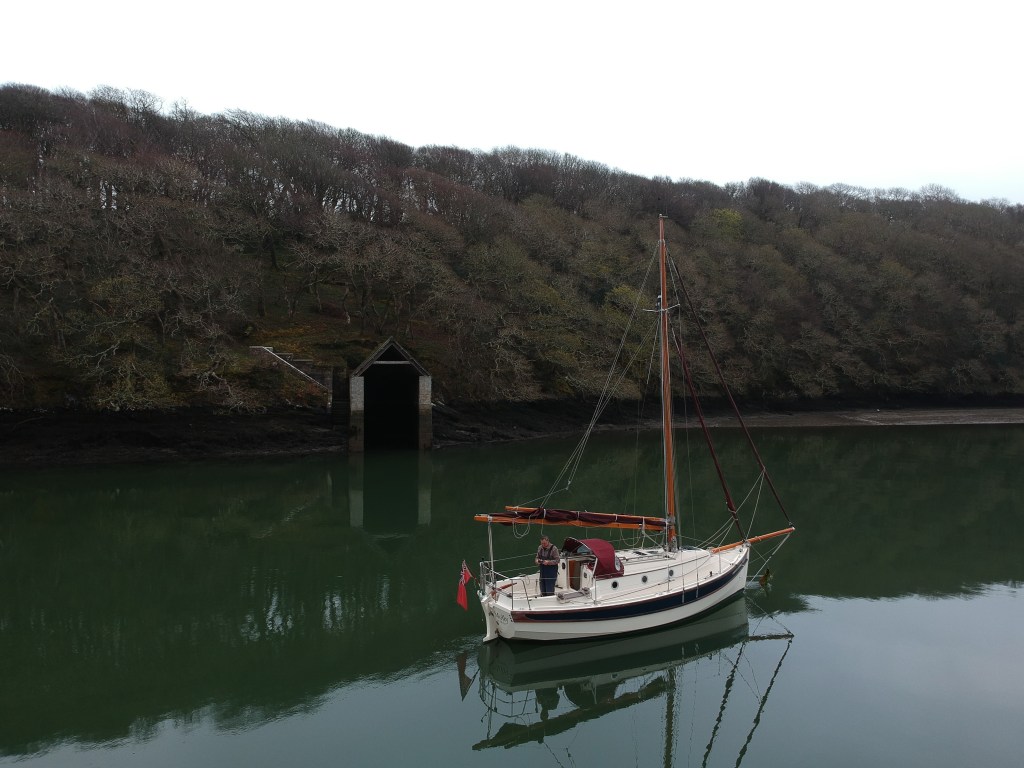
When I reached the mouth of the Helford, I experienced difficulty furling the staysail again and ended up dropping it on deck. Lazy jacks for the main are also going on the To-Do list! I motored up the river, past the multitude of moorings to Tremayne Quay. This is a lovely stone jetty and boat house which was built for a visit of Queen Victoria that she never made, and is a very fondly remembered spot we visited in our previous boat, Aurora.
The chart shows green here, but there is a “hole” outside the boathouse and I calculated that there would be at least 2m of water in that spot at low tide. Low tide was also conveniently before bedtime, so I could sleep soundly afterwards, knowing that there would be no need to check the anchor was re-set at the turn of the tide. In the event, the flow was gentle enough that the light breeze kept Molly in the same spot all night.
Tremayne QuayCanoes in the mist
It’s a very peaceful spot to stay, beyond most of the traffic and also easy to land, with pleasant walking in the woodland on the W shore. However, inflating the dinghy was a job for another night, I decided. Whilst in the calm I had a look at the reefing lines and decided that the difficultly in reefing was mainly down to friction in the single line system. I saw from the Crabber Club forum that I was not the first to experience this and instituted a simple change recommended there. I had bought some strong stainless rings from Trago before I left Falmouth and tied a pair of these through each of the reefing eyes. This means that the reefing line, instead of passing through the reefing eye, passes through the ring. This had the effect of swapping the reefing lines over in the cockpit, and makes it significantly easier to pull the reefs in. There is still a lot of friction for second reef and time will tell if this is a permanent change, or perhaps I will go a stage further and purchase some (much more expensive) low friction rings. In any case in the longer term I will need to make a tidier job of my current arrangement.
I was pleased to find my calculations correct; I did not touch at low tide and I spent a restful night on the river. In the morning, I made an earlyish start to leave before low – although there is enough water at low where I was anchored, I was not sure if I would get down the river at that time. Weighing anchor roughly 2hrs before LW, I weaved my way keeping to the deeper part of the channel and soon found my way to deeper water. There was almost no wind, so I motored over to St Makes. I dropped the pin in less than a metre of clear water at Cellars Beach, opposite Place House, a most elegant 16th Century manor, in which King Henry VIII had one of his multitude of marriages. I chose this spot not just for its outlook but to be out of the wash of traffic and spent most of the day working. What a great spot for an office!
In the evening I returned to Falmouth and inflated the tender for her inaugural voyage, rowing ashore for a pleasant evening with Ben.
Anchored with St Mawes in the background Lovely clear waterPlace Manor in the background
We passed a comfortable night aboard in Falmouth Yacht Haven, but the wind had been building during the night. Blowing a F5-6 from SE made for choppy conditions in the Carrick Roads and we did not feel ready to sail in that weather, because I was not confident of being able to set reefs properly. We decided to lay in some stores and find somewhere quiet up-river again. So it was Niki and I motored up the river and found a lovely sheltered spot just down from Malpas, which is as far as low tide reaches on the Truro river.
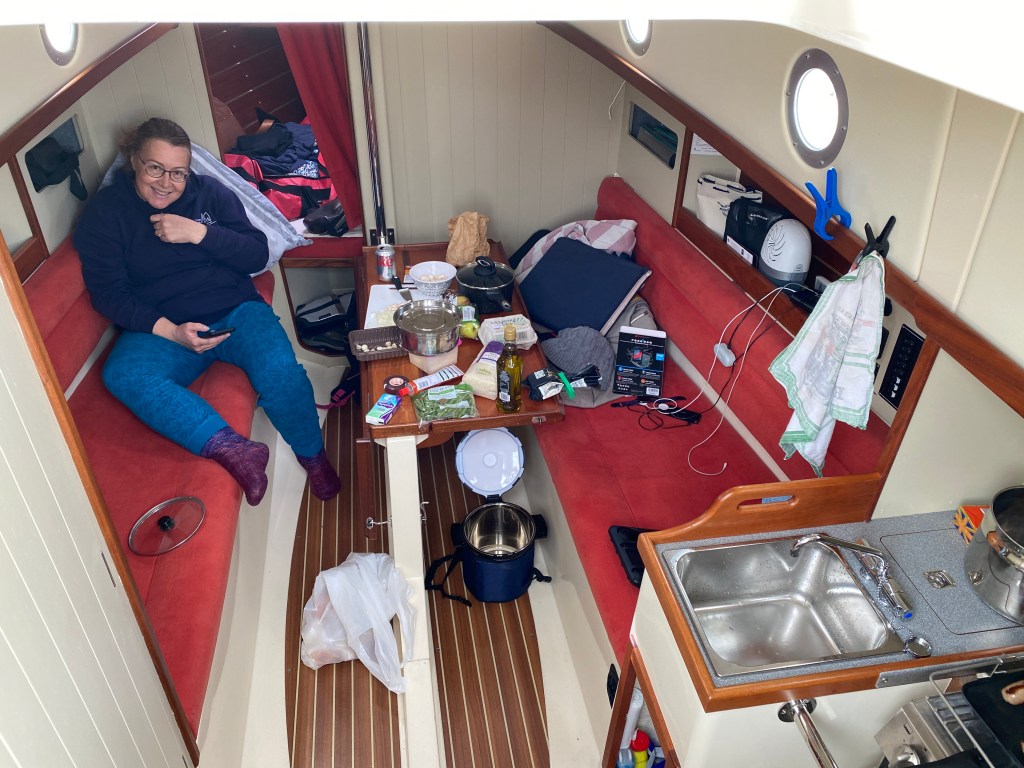
It is an idyllic spot, with the oak trees reaching to the water’s edge. This early in the season, the oak trees have yet to burst their buds, but there is little traffic and plenty of spots on the pontoon. Within the valley and protected by the trees, we were well sheltered from the wind and passed a relaxing afternoon and evening aboard, cooking a nice meal and listening to music. We were very pleased with the luxury of our facilities compared to Aurora, our trailer sailer – a comfortable saloon, oven, heating and hot water.
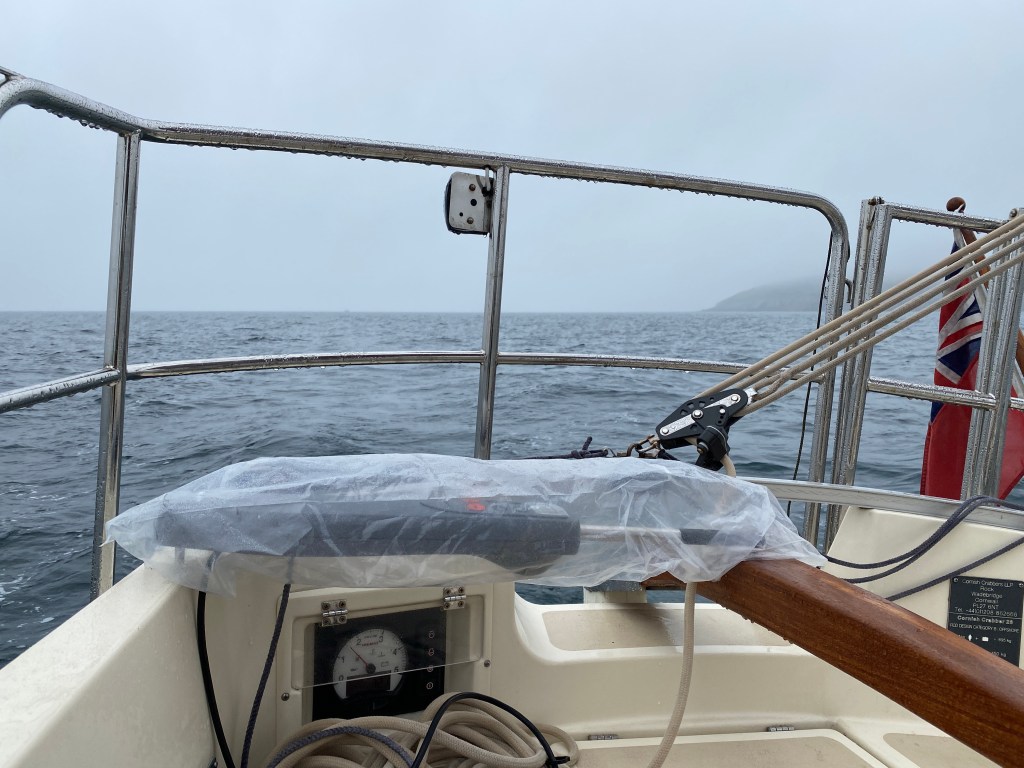
Niki having joined me again, we had decided to make our first passage in Molly, and the wind direction suggested Fowey. The weather made an un-inspiring start to the day, with drizzle and very poor visibility, so we delayed starting for an hour or two; the visibility had improved but the drizzle was annoyingly persistent.
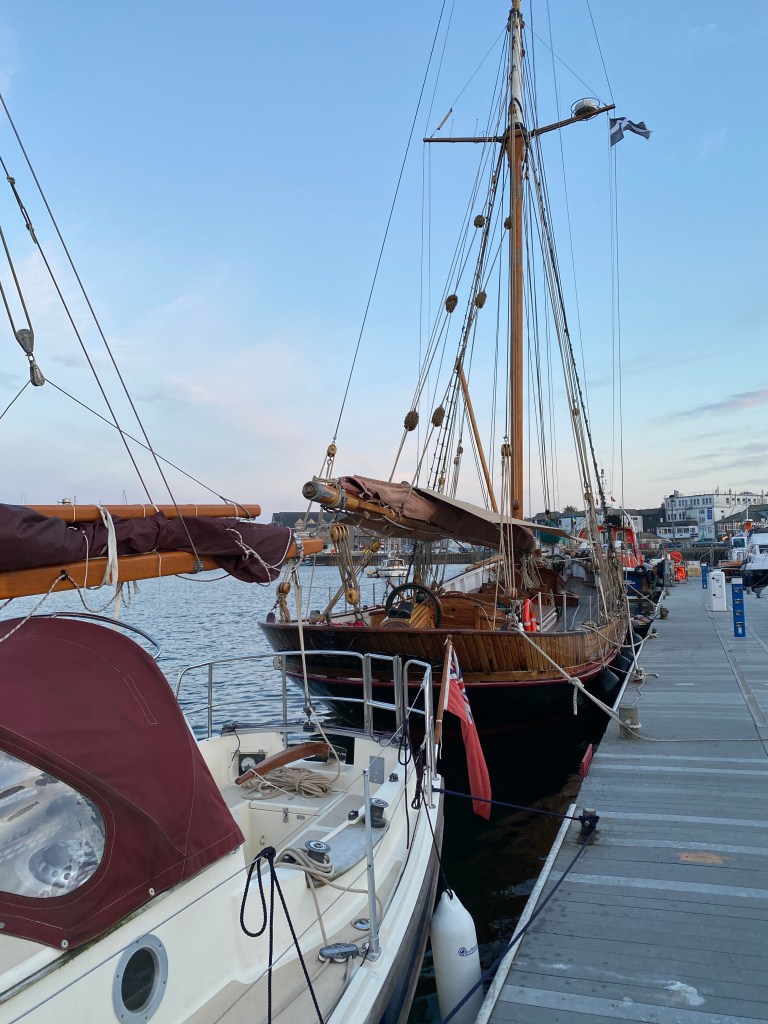
A rather glamorous neighbour on the pontoon at Falmouth Niki at the helm“Andy the arm” wearing his pac-a-mac against the rain
We tacked out the the Carrick Roads and finally settled on a close-hauled course towards Dodman Point, as yet invisible in the grey. Motor sailing, we were making a comfortable 4.5kt through the water and a little more than that over the ground. We had an anniversary brunch on the move, though Niki was feeling unwell and did not enjoy hers. We continued steadily NW and I was able to ease our course a little. Niki was asleep below, so I stopped the engine when we had passed Gwineas reef (a site I know well from diving there in the past) and we only lost a little less than a knot of boat speed. There were several large sailing vessels out off Mevagissey – Bessie Ellen an early C20 115ft trading ketch, now operated as a sailing experience vessel and also Pellew, a pilot cutter freshly-built in Penryn. They made a fine sight as we made our way steadily towards the mouth of the Fowey river.
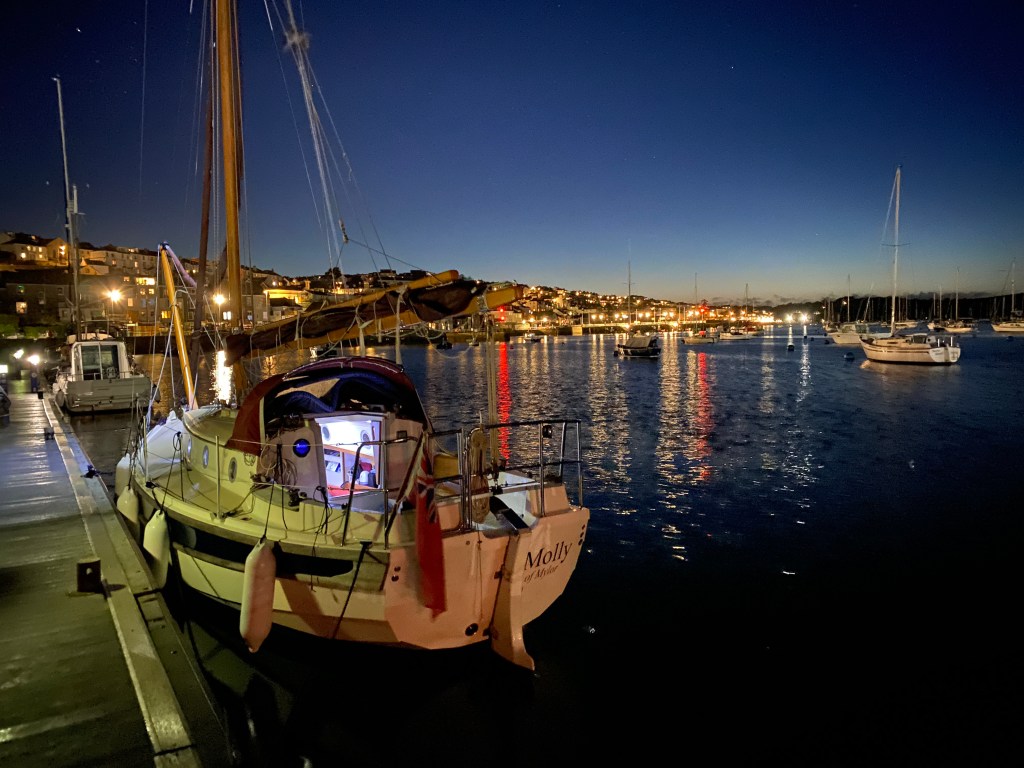
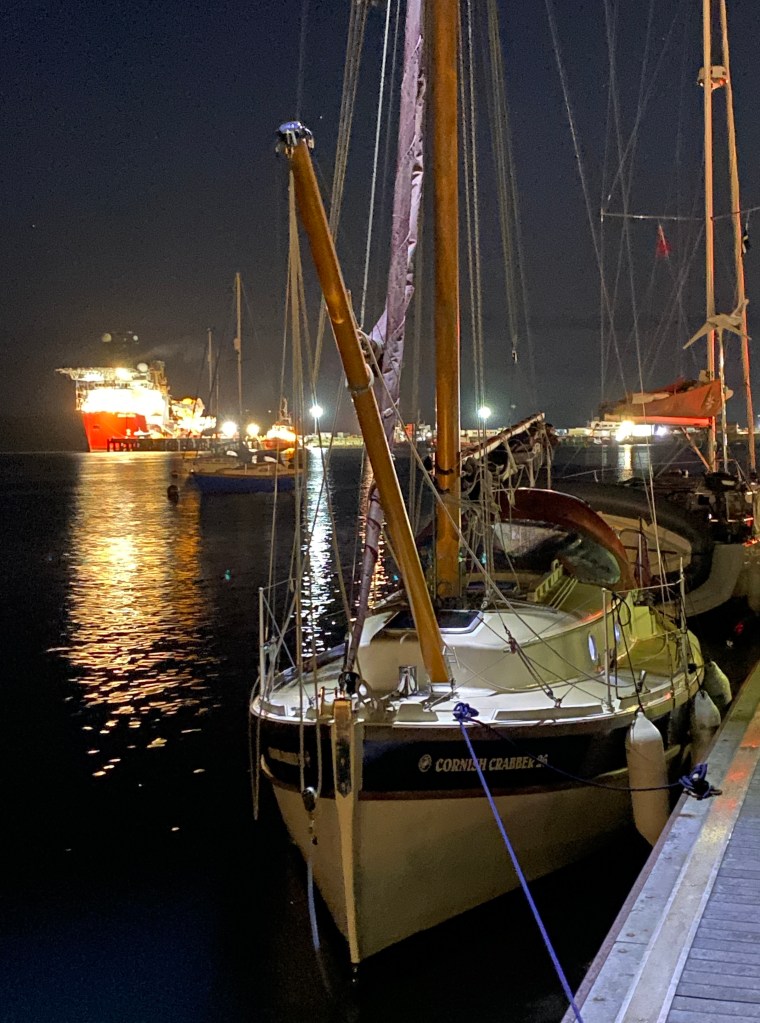
Niki picked up a mooring opposite the town, we inflated Aurelia and rowed across for dinner at the Ship Inn (a fine fish pie and some rather gritty Camel estuary mussels). Rowing back to Molly afterwards was easier than I feared – though it was mid-tide, there was not a very strong current in the river. We passed a rather rolly night – it seems in the light winds Molly kept turning across the swell. Perhaps we’ll use the pontoon next time…
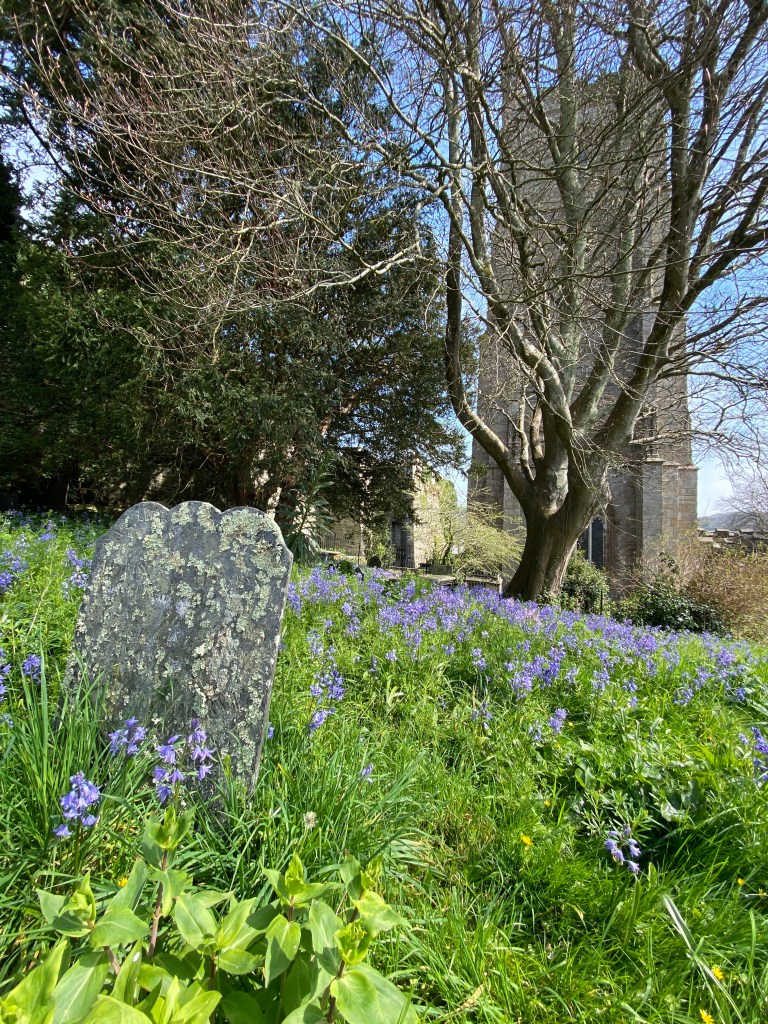
Fowey by nightFowey churchyard
In the morning, Niki and I decided to spend the day in Fowey and enjoyed a sunny morning wandering around this pretty town, busy with Easter tourists. We saw an RNLI stand which was being largely ignored, and chatted to the volunteer there. He told us there was an open evening planned for that afternoon, with the lifeboat to come up to the town quay at high tide for the public to have a look around and also that a shanty group would be performing.
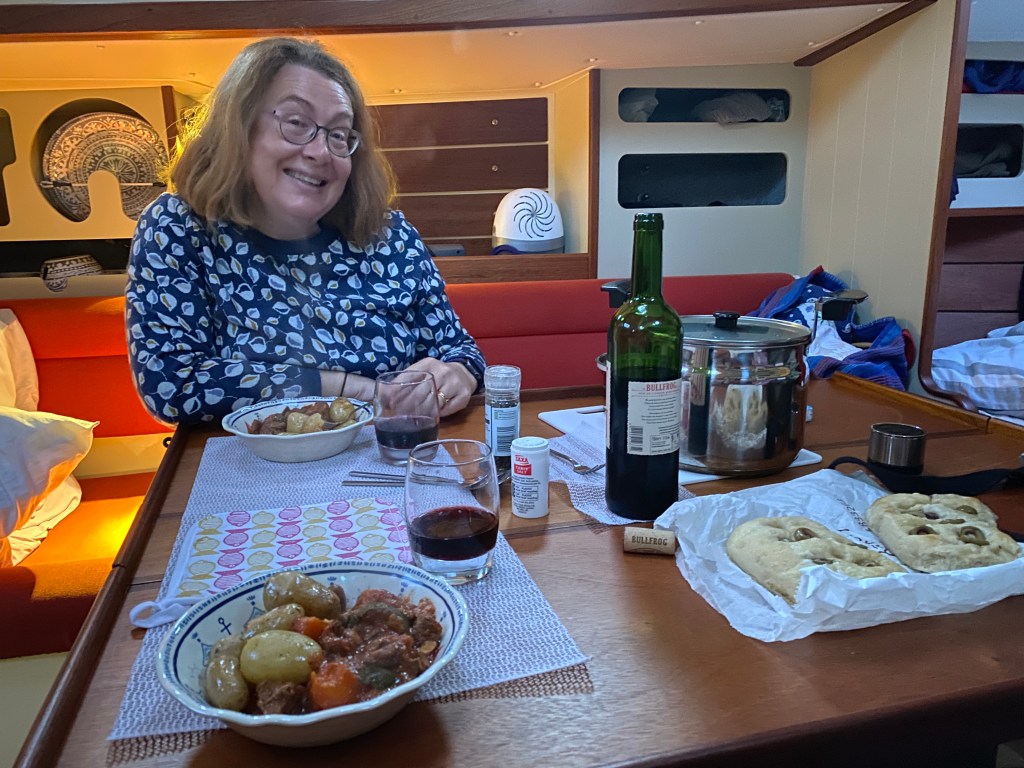
So our tender Aurelia got two trips across the river that day, as we returned to Molly, prepared a beef stew in our thermal cooker, to be eaten later, had a restful afternoon and returned to the town quay in late afternoon. The performance by local shanty group, Stuns’l, was excellent. It was just as well that this was our main reason for coming, as the lifeboat was nowhere to be seen, having been called out on a shout!
The harbour was very busy, so we kept our mooring, as we could see that all the pontoon berths were taken. We enjoyed a pleasant evening aboard with our beef stew and a film.
Stuns’ls (with no lifeboat in the background!)Lovely meal aboard
We set off in the morning with a lovely southerly and set a cracking pace, close hauled, expecting to bear away after the Dodman, and arrive back early enough to anchor somewhere for lunch, but the wind swung inexorably to the west and we ended up in a light air beat (with engine assistance). Sadly Niki had to return home that evening, but we were pleased with our first expedition.
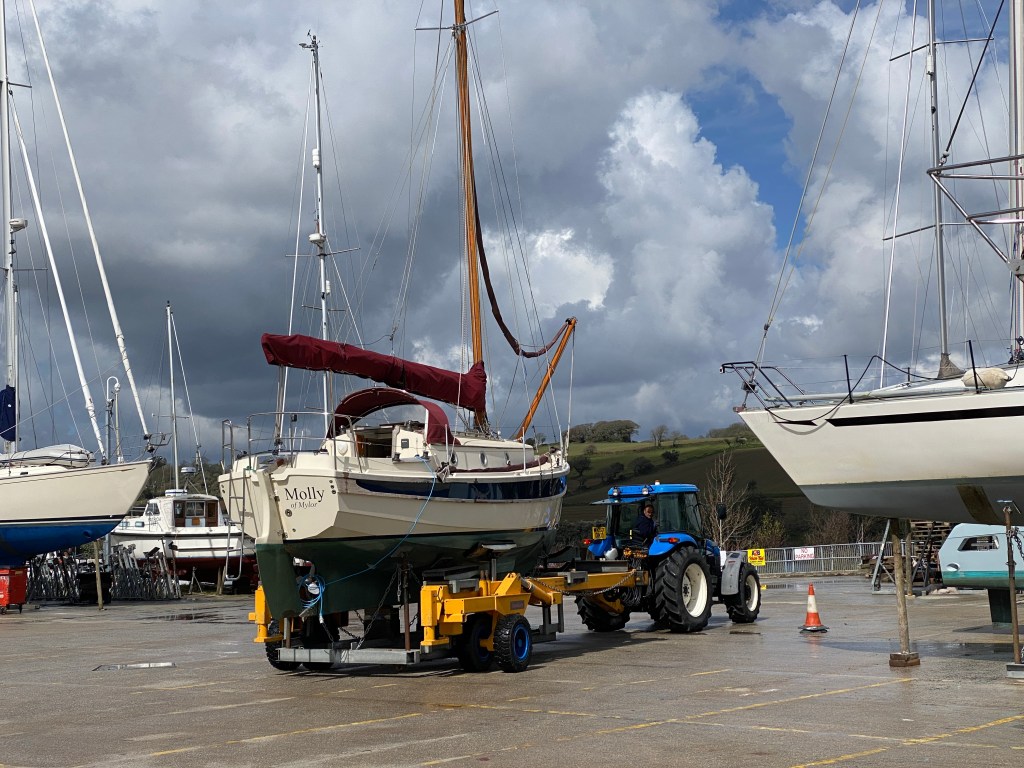
“Are you ready?”, he asked, an hour before our launch slot. Luckily we were, and so began our adventures on Molly of Mylor. I had been spending the winter months getting to know our new-to-us Cornish Crabber 26 and learning to carry out the winter maintenance tasks while ashore in the yard at Penryn in Falmouth. We had loaded our gear the previous day, before her cradle was moved from her winter store location to a spot near the slipway. Molly was quickly and efficiently lifted off the cradle and trundled down to the water; I had to remind myself that although this was a first for us, it was very much a routine task for the crew at the yard.
Molly being moved cradle and all, from her winter spot to the slipway Lifted off the cradleSplashdown!
The whole process was reassuringly uneventful and we warped her onto a pontoon and started the engine for the first time. Niki and I were joined by long-time boating friend and fellow Cornish Crabber owner, Russell. He was coming along to help us get used to manoeuvring Molly under engine, our previous boat being much smaller and lighter with an outboard.
The location we chose for our greenhorn boat handling were the pontoons up the Fal river past Turnaware Point. Conditions were ideal with little wind, warm sun and neap tides; it was a most enjoyable introduction to Molly. We soon reached the pontoons and both Niki and I practiced bringing Molly alongside up and down-wind. I was very pleasantly surprised with how well the Crabber 26 handles under engine both forward and astern.
It was now the time to try out the sails and we set full main, staysail and jib in the very light winds prevailing. Motor-sailing downriver, we were passed by Cornish Crabber’s owner Peter Thomas, aboard another ’26 – he took some photos of us and I was able to thank him for delivering a replacement luff spar onto the boat.
All sails set (photo: Peter Thomas)
The next item to try out was the anchor, so we put into St Mawes and dropped anchor in the harbour opposite the town to munch our pasties. Not much of a test of anchor holding, but good practice deploying and retrieving the tackle.
By this time, the wind had died to nothing and our attempts to sail in the bay achieved little, so we motored in to Falmouth, took a berth in the yacht haven and retired to town for a well-earned celebratory curry.













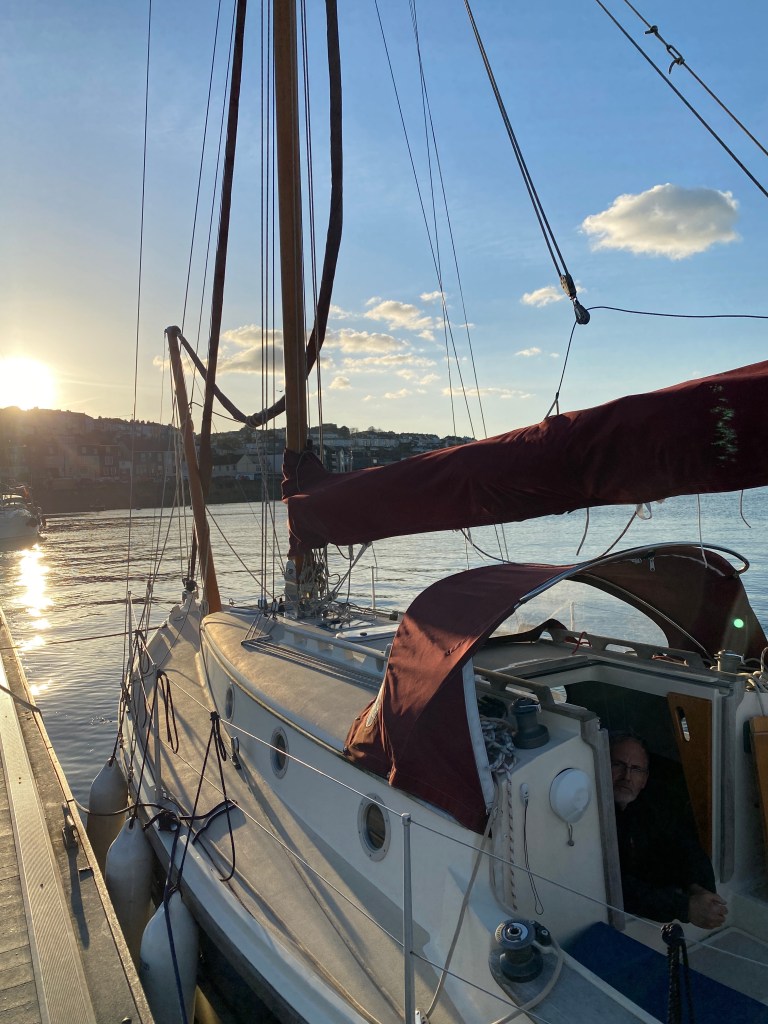
 Meandering Molly